The tiles
Dominoes Wild uses 66 tiles. Fifty-five are the tiles of the normal double-nine set. Eleven are wild tiles: one half is a wild half with no pips, drawn as an orange starburst and read out as "wild". Hands are hidden, so you see only your own tiles.
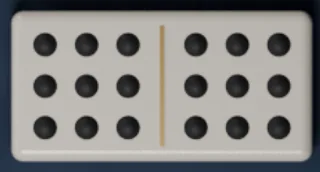
Number doublesCount: 10
The same number on both halves, from double blank (0-0) to double nine (9-9). A double is laid crosswise on the table and opens branches.
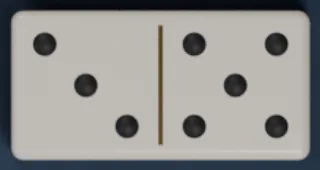
Other number tilesCount: 45
Two different numbers, such as blank-four (0-4) or three-five (3-5).
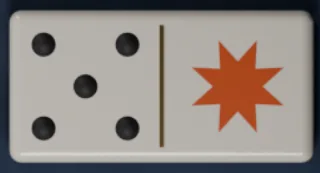
Wild tilesCount: 10
A number half and a wild half, such as five-wild. The wild half is an orange starburst.
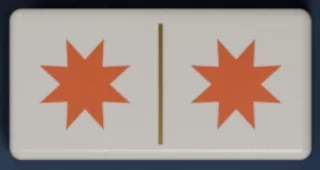
Double wildCount: 1
A wild half on both sides. It is a double, so it is laid crosswise and opens branches like every double.
66 tiles in all.
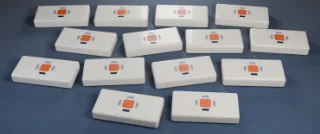
BoneyardCount: 1
The tiles left face down after the deal. In a Draw game you draw from it when you cannot play. In a Block game the tiles left over are set aside and never used.
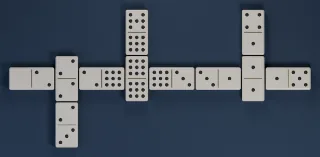
The layoutCount: 1
The tiles on the table. Every tile played joins one open end of a tile already there, and every double opens branches.
The tiles are shuffled and dealt face down, one at a time round the table. Everyone is dealt 7 tiles, as in Dominoes, so the boneyard is bigger.
| Players | Tiles each | Boneyard after the deal | Of those, can be drawn (Draw game) |
|---|---|---|---|
| 2 | 7 | 52 | 50 |
| 3 | 7 | 45 | 43 |
| 4 | 7 | 38 | 36 |
Goal
The game is played over several hands, exactly as in Dominoes: be first to play all your tiles, or be left with the fewest pips when nobody can play any more. The first side to reach the target score of 100, 150 or 250 wins.
Setup
In the first hand, the player holding the highest number double leads and must play it. The double wild never leads. If nobody holds a number double, the tiles are shuffled and dealt again. In later hands the leader may start with any tile, as in Dominoes.
Wild halves
A wild half matches any number and any wild half. So a tile with a wild half can be played on any open end. A tile with no wild half joins an end when one of its halves has the same number, as usual.
If an open end is wild, any tile can be played on it. A wild end stays wild until a tile covers it. Nobody names a number.
Sometimes you can lay a tile either way round. Then the game asks which half should face outward. Four-wild on an end showing 7 has only one way, because the wild half must touch. Four-wild on an end showing 4 has two: the wild half can touch and the 4 faces out, or the 4 can touch and the wild half faces out. Three-five on a wild end can show 3 or 5.
Example A wild end
two players; the layout is the single tile 3-5, with open ends 3 and 5
- Ben plays five-wild on the 5 end, with the wild half facing outward.
- The layout now has the open ends 3 and wild.
- Ana holds 2-7. It joins the wild end, and she chooses to show 7 outward.
The open ends are now 3 and 7. A wild end took a tile that matched nothing, and the end became a number again.
The double wild
The double wild is a double, so it is laid crosswise. Its far side and, once that has a tile, its top and bottom ends are all wild ends and take any tile. Because it matches anything, a double can be laid right against it, and the double wild can be laid against any double. Two ordinary doubles still never meet.
Fives scoring
Fives works as in Dominoes: after a tile is played, add up every open end, and if the total is a multiple of 5 the player scores it. A wild end counts 0. As in Dominoes, the app shows what the total would be, and whether it would score, when you pick a tile and point at an open end it fits.
At the end of a hand, each wild half left in a hand counts 10 pips. A tile such as four-wild is worth 14 and the double wild is worth 20.
Everything else
Turns, drawing and passing, blocked hands, partnerships, bots, running out of time and the end of the game all work as in Dominoes. See the Dominoes rules for the details. The table can be scrolled and zoomed in the same way.
Quick reference
- A wild half matches anything. A wild end takes any tile and stays wild until covered.
- When a tile can go either way round, you choose which half faces out.
- The double wild is a crosswise double and never leads the first hand.
- A wild end counts 0 in Fives. A wild half left in your hand counts 10.
- The deal is 7 tiles each, so the boneyard is 52, 45 or 38 tiles.
Glossary
- Boneyard
- The tiles left face down after the deal. In a Draw game you draw from it, except for the last two tiles, which stay. In a Block game the tiles are set aside and never used.
- Double wild
- The tile with a wild half on both sides. It is a double and is laid crosswise.
- Wild
- A half shown as an orange starburst. It matches any number and any wild half.
- Wild end
- An open end that shows a wild half. Any tile can be played on it, and it counts 0 in Fives.