The tiles
Dominoes uses one set of 55 tiles. Every tile has two halves, and each half shows 0 to 9 pips. A half with no pips is blank. Hands are hidden, so you see only your own tiles.
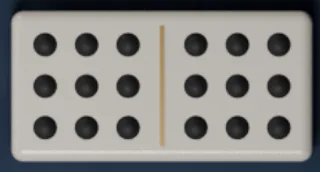
Double tilesCount: 10
The same number on both halves, from double blank (0-0) to double nine (9-9). A double is laid crosswise on the table and opens branches. It scores its pips in your hand like any tile.
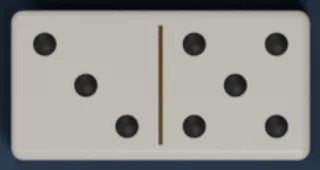
Other tilesCount: 45
Two different numbers, such as blank-four (0-4) or three-five (3-5). Every pair of different numbers from 0 to 9 appears once.
55 tiles in all.
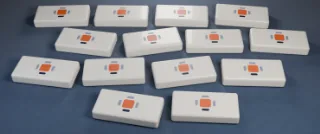
BoneyardCount: 1
The tiles left face down after the deal. In a Draw game you draw from it when you cannot play. In a Block game the tiles left over are set aside and never used.
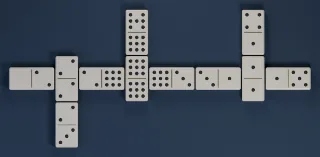
The layoutCount: 1
The tiles on the table. Every tile played joins one open end of a tile already there, and every double opens branches.
In this guide a tile is written as its two numbers, low first, such as 3-5. A double is written 5-5. In the app a tile is read out as "three-five" or "double-five". The tiles are shuffled and dealt face down, one at a time round the table.
| Players | Tiles each | Boneyard after the deal | Of those, can be drawn (Draw game) |
|---|---|---|---|
| 2 | 7 | 41 | 39 |
| 3 | 7 | 34 | 32 |
| 4 | 7 | 27 | 25 |
Your hand is always shown sorted from the lowest tile to the highest, and a tile you draw slides into its place. There is nothing to sort and no sort button.
Goal
Dominoes is played over several hands. In each hand you try to be the first to play all your tiles, or to be left with the fewest pips when nobody can play any more. The side that wins a hand scores points, and the first side to reach the target score wins the game.
The target is chosen when the table is set up: 100, 150 or 250 points. With four players a side is a partnership of two, and the partners share one score.
Setup
The tiles are shuffled and dealt face down, one at a time, round the table, until everyone has their tiles (see the table above). The tiles left over are the boneyard.
In the first hand, the player holding the highest double leads and must play it as the first tile. The highest double is double nine if anyone holds it, then double eight, and so on down to double blank. A double that is in the boneyard does not count. If nobody holds any double, the tiles are shuffled and dealt again, as often as it takes.
Example Who leads the first hand
two players, Ana and Ben, 7 tiles each; the doubles Ana holds are [1-1, 2-2, 3-3]; Ben holds [0-0, 4-4]; the doubles 5-5 to 9-9 are in the boneyard
- Ana holds the doubles 1-1, 2-2 and 3-3. Ben holds 0-0 and 4-4. The highest double in anyone's hand is 4-4.
- Ben leads and must play 4-4. The game offers him that one tile and nothing else.
- The layout is now one double with a 4 on each of its two sides. Ana plays next.
Ben led because he held the highest double. In every later hand the leader may start with any tile.
In every later hand the leader is chosen by the rule in Going out and blocked hands (the player who went out, or after a blocked hand the player described there), and the leader may start with any tile.
A turn
On your turn you must play a tile if you can. If you cannot, what you do depends on the game: in a Draw game you draw tiles until you can play or nothing more can be drawn, and in a Block game you pass.
- Look at the open ends of the layout. There can be many.
- If you hold a tile with a half that matches an open end, play it at that end. You choose which tile and which end.
- If you hold no matching tile, draw (Draw game, while you may) or pass.
The game will not let you draw or pass while you hold a tile you can play. It tells you why, and nothing is counted against you. It will not let you pass while you can still draw either. When you cannot play and nothing can be drawn, the game passes for you at once.
The layout and matching
The first tile of a hand starts the layout. Every tile after it joins one open end of a tile already on the table. A tile can join an open end when one of its halves has the same number of pips as that end shows. The table is drawn as it would look on a real table, and on a touch screen you can drag it to scroll and pinch to zoom; a double tap switches between seeing the whole layout and the normal size.
- The matching half touches the end, and the other half becomes the new open end. You never turn a tile yourself: the game turns it for you.
- A tile that fits several open ends can be played at any of them, and you choose which. This is true even when two ends show the same number.
- The app names every open end when it offers a play, for example "the open end of the three-five" or "the far side of the double-four".
Doubles branch
Every double is laid crosswise, straddling the tile it touches, and it is never placed in line. A double opens branches:
- Its far side is the side opposite the one that touches. The line carries straight on from there.
- Its two ends, at the top and the bottom of the crosswise double, branch out sideways, one each way.
- The line comes first, then the branches. The top and bottom ends of a double are waiting ends until every side of it has a tile: for a double you join, that means its far side; for the double that starts the game, both of its sides. Until then you can play only on the sides.
- This is true of every double, in every game, at every number of players. It is not a table setting.
Two more things follow. The double that starts the first hand has two open sides and its top and bottom wait for both of them. And a double never joins another double, because every end of a double shows the double's own number and there is only one double of each number.
Example Joining the layout
the layout is the double 2-2 alone; Ben holds [0-1, 0-3, 1-2, 1-4, 1-5, 3-4, 4-6, 5-5, 6-6] among other tiles
- The two sides of the double both show 2. Ben holds 1-2, which has a 2.
- Ben plays 1-2 on the right side of the double. The 2 touches the double and the 1 faces out.
The layout is 2-2 with 1-2 on its right. The open ends are the left side of the double (a 2) and the end of the 1-2 (a 1). The double's top and bottom ends are still waiting for its left side.
Example A double opens its branches
Ana and Ben; the layout is 1-3 with the double 3-3 laid crosswise on its 3 end; the far side of the double shows 3; the top and bottom ends are waiting; Ben holds 3-6 and Ana holds 2-3
- Ben plays 3-6 on the far side of the double. The far side now has a tile.
- The double's top and bottom ends open. Both show 3.
- Later, Ana plays 2-3 on the top end. The bottom end is still open for any tile with a 3.
One double has turned a single line into four open ends: the 1 end of 1-3, the end of 3-6, the end of 2-3 and the bottom end of the double.
Drawing and passing
In a Draw game, when you cannot play you draw from the boneyard, one tile at a time, until you hold a tile you can play. You then play it. You may not draw while you hold a playable tile.
- The last two tiles of the boneyard stay where they are. They can never be drawn, so a player who has drawn everything else and still cannot play simply passes.
- Each tile you draw is picked at random by the game, never by you or by what you send. Online, every shuffle and every draw is made by the server. In an offline practice game against bots, it is made by the game on your own device, which is the referee for that game. Nobody else can see which tile you drew; others see only that you drew.
- A player who keeps drawing can end up holding many tiles: at most 46 with two players, 39 with three and 32 with four, because only the drawable tiles can be taken. The hand then scrolls sideways on a small screen.
- In a Block game there is no drawing at all. If you cannot play, you pass.
- You pass only when you cannot play and cannot draw. You never have to press anything: the game passes for you at once.
Everyone sees when you draw or pass, and so everyone learns that you held no tile for the open ends at that moment. That is part of the game.
Example Drawing until a tile fits
two players, Draw game; the layout is the double 2-2 alone with a 2 on each side; Ben holds 7 tiles, none with a 2; 41 tiles are in the boneyard, 39 of them can be drawn
- Ben holds no 2, so he cannot play and must draw.
- Ben draws a tile that does not fit, and 38 tiles can still be drawn. He draws again.
- Ben draws 2-3, which fits. He now holds 9 tiles and 37 tiles can still be drawn.
- Ben may no longer draw or pass. He plays 2-3.
Ben drew twice, then played. Ana saw that he drew twice, but not which tiles.
Table options
Dominoes has four table settings. The first three change the rules; the fourth is only about rematches. The version with wild tiles is a separate game, Dominoes Wild, with its own rules page.
| Setting | Choices, in this order | Default |
|---|---|---|
| Game | Draw, Block | Draw |
| Scoring | Straight, Fives | Straight |
| Target | 100, 150, 250 | 100 |
| Seats on a rematch | Keep, Shuffle | Keep |
- Draw: a player who cannot play draws from the boneyard until they can, or until only the two reserved tiles are left.
- Block: nobody draws. A player who cannot play passes. The tiles left over after the deal stay set aside, face down.
- Straight: points are scored only for winning a hand.
- Fives: points are also scored during play, whenever the open ends of the whole layout add up to a multiple of 5. See Fives scoring.
- Target: the game ends when a side reaches this score.
- Seats on a rematch: Keep gives everyone the same seat again, so partners stay partners. Shuffle draws the seats again, which can make new partnerships.
Fives goes with either game, Draw or Block. Dominoes hands are hidden, so a table cannot be played with several people sharing one screen.
Every table also has the usual settings for how long a turn may take. They depend on where the table was made:
- An ordinary table: a real-time turn timer of Relaxed (45 seconds), Normal (30 seconds, the default) or Fast (15 seconds), or a turn-based time of 12, 24 or 72 hours per turn. See Running out of time and leaving.
- A table in a Room: the timer is off unless the owner turns it on. With the timer off, nothing ever changes because time passed.
- Bots: a seat can be given to a bot when the table is set up. See Bots.
Fives scoring
With Fives scoring, after every tile played you add up the pips counted at every open end of the whole layout. If the total is a multiple of 5 (5, 10, 15, 20 and so on), the side that played the tile scores that many points. A total of 0, or any total that is not a multiple of 5, scores nothing. Waiting ends count nothing. In a Fives game, when you pick a tile and point at an open end it fits, the app shows what the total would be and whether that would score, before you play.
How the open ends are counted:
- An end of an ordinary tile counts its outer half, the half that faces out.
- A double whose far side is open counts both of its halves: an open 6-6 adds 12.
- Once the far side of a double has a tile, its top and bottom ends are open and each counts the double's number. A double you have joined therefore never adds more than twice its number.
- The double that starts the game counts its number on each side while it is alone, so 5-5 alone is 10. When one side has a tile, the other side counts both halves, and when both sides have tiles its top and bottom count 5 each.
- A single tile at the start counts both of its halves, one on each side.
The total is added up over all the open ends of the layout, however many there are, and it can be large. The points are the total itself: a total of 15 scores 15 points and a total of 60 scores 60. Only the player who played the tile, and that player's partnership, scores. Drawing and passing never score.
Example Fives points during a hand
two players, Fives scoring; Ana leads and holds, among other tiles, [1-3, 1-4, 5-6]; Ben holds, among other tiles, [2-3, 3-3, 3-6]
- Ana plays 1-3. The ends add up to 1 + 3 = 4. No score.
- Ben plays 3-3 crosswise on the 3 end. Its far side is open and counts both halves, 6, and the other end shows 1. The total is 7. No score.
- Ana plays 1-4 on the 1 end. The ends add up to 4 + 6 = 10. Ana scores 10.
- Ben plays 3-6 on the far side of the double. Now its top and bottom ends are open, 3 each, and the other ends show 4 and 6. The total is 3 + 3 + 4 + 6 = 16. No score.
- Ana plays 5-6 on the end of the 3-6. The total is 3 + 3 + 4 + 5 = 15. Ana scores 15.
Ana has 25 points and Ben none. The double counted both halves at its far side, then 3 at each of its two branch ends.
Going out and blocked hands
A hand ends in one of two ways.
- Domino. A player plays their last tile, which is called domino. The hand ends at once.
- Blocked. No player can play on any open end of the layout, and nothing can be drawn (in a Draw game the two reserved tiles stay put, and in a Block game nothing is ever drawn). The game notices this by itself and ends the hand. Nobody has to pass round the table first.
Scoring a hand
When a hand ends, count the pips left in each side's hands. With four players, a partnership counts both partners' hands together. Tiles on the table, in the boneyard and in the reserve are never counted.
- Domino: the side of the player who went out scores the pips left in the hands of every other side. A partner's tiles are not counted for either side.
- Blocked: the side with the lowest total pips wins the hand, and scores the pips left in the hands of every other side. It does not subtract its own pips.
- Blocked tie: if two or more sides share the lowest total, nobody scores, and the next hand is dealt.
With Straight scoring the amount is the exact number of pips. With Fives scoring it is rounded to the nearest multiple of 5: 1 or 2 more than a multiple of 5 rounds down, and 3 or 4 more rounds up. So 12 pips score 10, and 13 pips score 15. Rounding applies to a blocked hand too.
Example Going out with four players
four players in partnerships, Ana and Cara against Ben and Dev, Fives scoring; Ana holds only 2-3 and plays it; Ben holds 2-5, Cara holds 0-6 and 4-4, Dev holds 1-5; the score is Ana and Cara 40, Ben and Dev 30
- The layout is the double 3-3 with 3-4 on its right. Ana plays 2-3 on its left and has no tiles left. She goes out, and the hand ends. Now both sides of the double have a tile, so its top and bottom ends open. The ends add up to 3 + 3 + 4 + 2 = 12, which scores nothing.
- Ben and Dev hold 7 + 6 = 13 pips. Cara's tiles, 14 pips, are not counted for anyone.
- With Fives scoring 13 rounds to 15. Ana and Cara score 15.
Ana and Cara now have 55 and Ben and Dev have 30. With Straight scoring they would score exactly 13. Ana leads the next hand.
Example A blocked hand, and a tie
four players, Block game, Straight scoring; the layout has a 5 at each open end; nobody holds a 5; Ana and Cara hold 23 + 22 = 45 pips together, Ben and Dev hold 19 + 25 = 44
- No player can play and nothing can be drawn, so the hand is blocked.
- Ben and Dev have the lowest total, 44, so they win the hand.
- They score the other side's pips, 45. They do not subtract their own 44.
Ben and Dev score 45. In another hand both sides hold 39 pips, so nobody scores and a new hand is dealt.
The leader of the next hand is:
- after a domino, the player who went out;
- after a blocked hand with a winner, the player of the winning side who holds fewer pips (on a tie, the lower-numbered seat);
- after a blocked tie, the player to the left of the previous leader.
Partnerships
With four players, the two players who sit opposite each other are partners. Partners share a score, and a partner's play can score for you. Partners never see each other's tiles, and the game has no way to pass them information.
With two or three players everyone plays alone. There are no partnerships with two or three players, and no individual game with four.
How the game ends
The game ends at once when a side reaches or passes the target score: 100, 150 or 250 points. That can happen at the end of a hand, or in the middle of a hand with Fives scoring, as soon as a play takes the score to the target. The score is not capped, so a side can finish above the target.
If the game ends in the middle of a hand, the hand is not scored and nobody's tiles are shown.
The score is checked after each scoring step, so the game stops at the first side to reach the target. Two sides can never reach it together, so there is never a tie to settle.
Example Reaching the target in the middle of a hand
two players, Fives scoring, target 100; Ana has 85 points and Ben has 60; Ana leads and holds, among other tiles, 2-3 and 2-4; Ben holds, among other tiles, 3-6
- Ana plays 2-3. The ends add up to 5, and Ana scores 5: she has 90.
- Ben plays 3-6 on the 3 end. The open ends are 2 and 6, which add up to 8. No score.
- Ana plays 2-4 on the 2 end. The open ends are 4 and 6, which add up to 10. Ana scores 10 and reaches 100.
Ana wins the game at once, 100 to 60. The hand is not counted and no tiles are turned over.
What you can see
You see your own tiles, how many tiles each other player holds, the layout, which ends are open and which are still waiting, the scores, and how many tiles can be drawn from the boneyard (in a Draw game the app also says that two are kept back). You do not see the other hands, the boneyard, or which two tiles are the reserve.
When a hand ends, every player's remaining tiles are shown so the pips can be counted. The boneyard itself is never shown, though a careful player can work out which tiles were left in it from the tiles that are shown. That is part of the game.
All shuffling and drawing is done by the game, never by you: nothing you send can change a shuffle or a draw. Online the server does it; in an offline practice game against bots your own device does it.
Bots
A Dominoes table can include bots. A bot sees only what a player in its seat would see: its own tiles, the layout, the scores and how many tiles each other player holds. It never sees another hand or the boneyard.
- Easy plays one of its legal moves, chosen by a fixed rule, so the same position always gives the same move.
- Normal and Hard levels come later in the app's life. The table lists only the levels that exist.
Running out of time and leaving
If your turn timer runs out (when there is one), the game plays a plain move for you so the table can go on. It plays your tile that fits with the most pips (on a tie, the lower tile), at the first end the app lists if it fits several, or it draws if you must draw. Passing needs no clock: the game passes for you at once.
At an ordinary real-time table, after your third timeout in a game a bot takes your seat for the rest of that game. At an ordinary turn-based table, when your time runs out a bot plays that turn, or you forfeit if the host chose that when the table was made. At a table in a Room no bot ever takes a person's seat and nobody forfeits because of time: if someone leaves or loses their connection, the game pauses and the Room owner decides what happens to the seat.
If you forfeit at an ordinary table, the whole game ends at once, not just your part in it. The hand in progress is not scored and no tiles are shown. With two players the other player wins. With four players your whole partnership loses. With three players you are ranked last and the others are ranked by score; if they have the same score they share the first place and nobody is named the winner. Leaving a game that has no other person in it simply ends it, and counts as neither a win nor a loss.
Undo. When you play alone against bots, an Undo control takes back your last move, together with the bots' moves and automatic passes after it, and the game is marked as practice. It is not offered at a table with another person. You can never take back a draw, and you cannot take back a move once a tile was drawn after it or the hand ended. See Bots.
Rematch. After a game the host can offer a rematch with the same settings. The Seats on a rematch setting decides whether everyone keeps their seat or the seats are drawn again. A seat whose person left stays open for the host to fill; it is never given to a bot automatically.
Dominoes is free: anyone can create and start a table, and everyone who joins plays without buying anything.
Quick reference
A turn: play a tile that matches an open end of the layout. If you cannot, draw (Draw game) or pass (Block game).
| Players | Tiles each | Boneyard | Can be drawn (Draw) |
|---|---|---|---|
| 2 | 7 | 41 | 39 |
| 3 | 7 | 34 | 32 |
| 4 | 7 | 27 | 25 |
- The first hand starts with the highest double, which must be played first. No double in anyone's hand means a new deal.
- Every double is laid crosswise. Its top and bottom ends stay waiting until every side of it has a tile.
- You cannot draw or pass while you hold a tile you can play.
- Fives: after a tile is played, add up every open end of the layout. If the total is a multiple of 5, the player scores that total. A double counts both halves while its far side is the tip of the line; once that side has a tile, its top and bottom ends count its number each.
- Domino or blocked: the winning side scores the pips left in the other sides' hands. In Fives scoring the amount is rounded to the nearest 5. A blocked tie scores nothing.
- The game ends the moment a side reaches 100, 150 or 250.
Glossary
- Blocked
- A hand in which no player can play on any open end and nothing can be drawn. It ends at once, and the side with the lowest total pips wins it.
- Boneyard
- The tiles left face down after the deal. In a Draw game you draw from it, except for the last two tiles, which stay. In a Block game the tiles are set aside and never used.
- Domino
- In this guide, the name for playing your last tile (the game itself is called Dominoes). It ends the hand at once.
- Double
- A tile with the same number on both halves, such as 5-5. It is laid crosswise and opens branches. In Fives scoring it counts both halves while its far side is the tip of the line, and its number at each of its top and bottom ends once the far side has a tile.
- End
- A place where a tile can be joined. An open end shows a number, and a tile can join it when one of its halves has the same number of pips.
- Far side
- The side of a crosswise double opposite the one that touches the tile before it. The line carries straight on from the far side.
- Forfeit
- Leaving an ordinary game in progress that has other people in it. It ends the whole game at once, and the player who left, or the whole partnership with four players, loses.
- Layout
- The tiles on the table. It starts with one tile and grows as tiles join open ends, and every double opens branches.
- Partnership
- With four players, two partners who sit opposite each other and share one score.
- Pip
- One of the dots on a half of a tile, 0 to 9 per half. The pips left in your hand when a hand ends are what the other side scores.
- Reserve
- The last two tiles of the boneyard in a Draw game. They stay where they are and can never be drawn.
- Waiting end
- The top or bottom end of a double before every side of it has a tile. Nothing can be played on a waiting end yet, and it counts nothing in Fives.