The cards
Cribbage uses one ordinary deck of 52 cards, with no jokers. There are four suits, Spades, Hearts, Clubs and Diamonds, and each suit has thirteen cards: Ace, 2, 3, 4, 5, 6, 7, 8, 9, 10, Jack, Queen and King. Every card is told apart by its suit symbol and its rank, so you never have to rely on color alone.
Each card has two numbers, and it is easy to mix them up. The rank is used for pairs and runs. It runs from Ace as 1, then 2 to 10, then Jack as 11, Queen as 12 and King as 13. The Ace is always low, and a run never wraps round, so King, Ace, 2 is not a run. The count value is used for fifteens and for pegging. It is the number on the card for 2 to 10, an Ace is 1, and Jack, Queen and King are all worth 10.
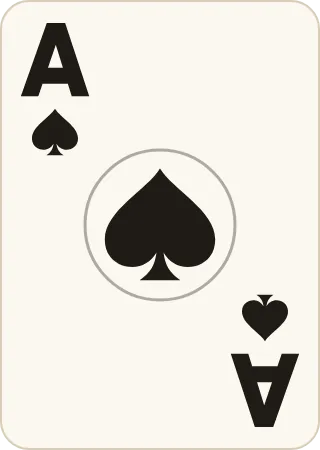
AcesCount: 4
One in each suit. Rank 1, the lowest card: a run can be Ace, 2, 3 but never continues from the King round to the Ace. Counts 1 towards a fifteen and towards the 31 of pegging.
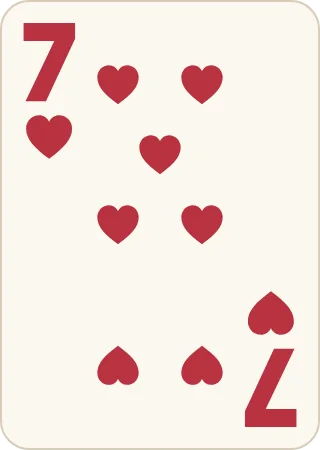
2 to 9Count: 32
Eight ranks in four suits. The rank and the count value are both the number on the card: a 7 counts 7 towards fifteen or 31, and sits between the 6 and the 8 in a run. A 5 makes fifteen with any of the sixteen cards that count 10.
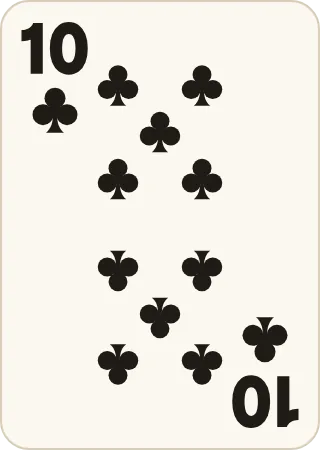
10sCount: 4
One in each suit. Counts 10 towards a fifteen and towards 31. Rank 10, so it runs with the 9 and the Jack, and a 10 and a Jack are not a pair.
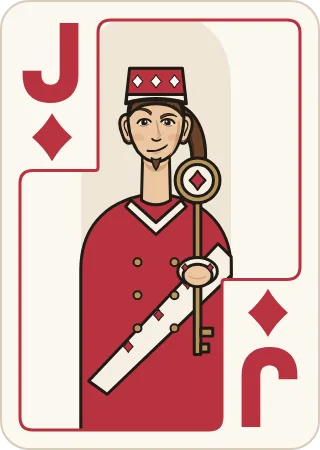
JacksCount: 4
One in each suit. Counts 10. Rank 11, between the 10 and the Queen in a run. A Jack turned up as the starter scores 2 for the dealer at once, called his heels, and a Jack in a hand or in the crib of the same suit as the starter scores 1, called his nobs.
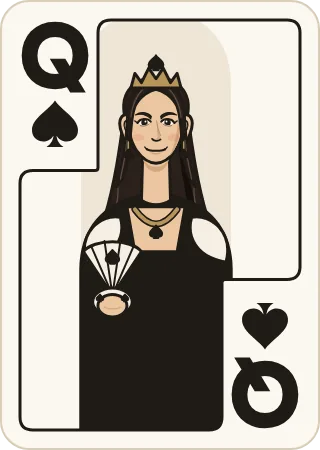
QueensCount: 4
One in each suit. Counts 10. Rank 12, between the Jack and the King in a run.
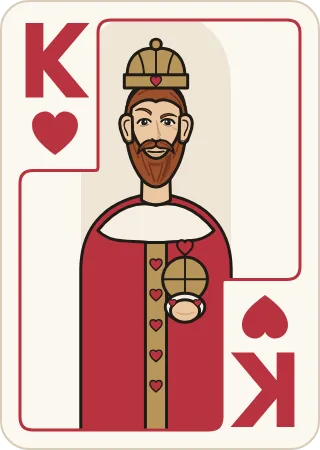
KingsCount: 4
One in each suit. Counts 10. Rank 13, the highest card, so a run never continues past it.
52 cards in all.
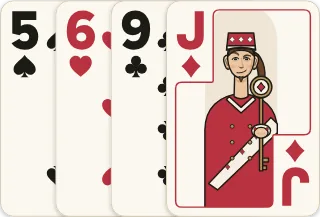
Your handCount: 4
You are dealt six cards (two players) or five cards (three or four players) and keep four after you put cards in the crib. It is always shown sorted by suit, Spades then Hearts then Clubs then Diamonds, and within a suit from Ace up to King, with no control to change it.
The cribCount: 4
A fourth hand made of the cards that every player puts in, face down. It belongs to the dealer and nobody sees it, not even the dealer, until it is counted in the show. With three players the dealer's deal puts one extra card in it from the deck.
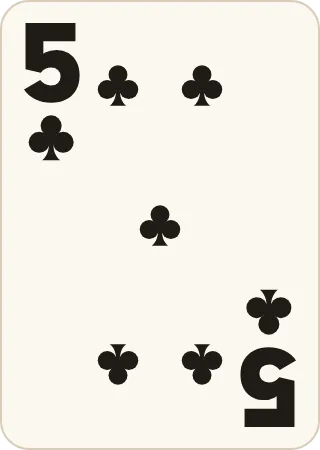
Starter cardCount: 1
One card turned face up from the deck after the discards. Everyone can see it. It is counted as a fifth card in every hand and in the crib, and it is never played during pegging.
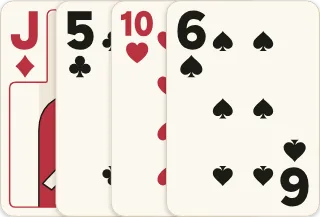
Pegging areaCount: 1
The place in the middle of the table where played cards are laid in order, with the running count shown beside them. Cards stay there until the round ends, and everyone can see who played what.

Cribbage boardCount: 1
A long wooden board with one lane for each side that scores. Each lane has 120 holes in two rows of 60, in groups of five, with a small brass dot between groups. A start hole for each peg sits at one end, and the 121 finish hole, ringed in brass, sits at the same end, between the two rows.
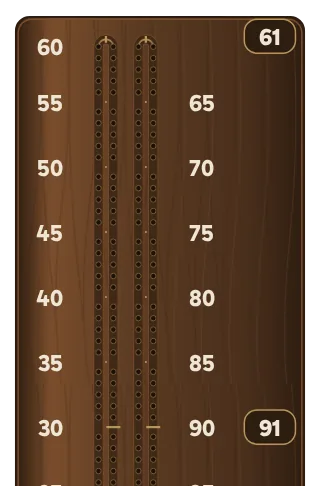
Skunk linesCount: 2
Two brass bars. One crosses the curve at the far end of the board between holes 60 and 61, labelled 61. The other crosses the returning row between holes 90 and 91, labelled 91. They show how many games a win is worth, as the Scoring section explains.

PegsCount: 2 per side
Each side has a front peg and a back peg in one color. The front peg shows the side's score. The back peg shows the score that side had before its latest scoring. Four peg colors are offered, each with its own shape so you never have to rely on color: Terracotta circle, Teal square, Oat diamond and Navy triangle.
Totals chipCount: 1 per sideOn screen
A small panel beside the board for each side, showing the peg shape, the color name, the score, how many points that side has to go and which skunk zone it is in. The board is never shown without these totals.
Games wonCount: 1 per sideOn screen
A count of the games each side has won in the match, with a skunk counted as 2 games and a double skunk as 4.
The deal depends on the number of players. With three players one card goes from the deck straight into the crib. The cards left in the deck are what the starter is cut from.
| Players | Cards dealt to each player | From the deck to the crib | Left in the deck after the deal |
|---|---|---|---|
| 2 | 6 | none | 40 |
| 3 | 5 | 1 | 36 |
| 4 | 5 | none | 32 |
Two pegs on a side leapfrog along a lane, and the pair together always show where that side is and where it has just come from. A side starts a game with its pegs in the start holes at a score of 0. At 121 the front peg enters the finish hole.
The board
The number of lanes depends on how many sides are scoring. Two players use two lanes. Three players use three lanes. Four players always play in two partnerships, so they use two lanes, one for each partnership, and partners share the lane and the peg color. Each lane runs along one row of 60 holes from the start, round the curve at the far end, and back along the other row of 60 holes to the finish hole at the end where you started.
The game ends at 121, and the board's last hole is the finish. If an award would take a score beyond 121, the peg stops at the finish hole.
On a phone the board itself may be hidden because the screen is too small, and then only the totals chips are shown. Wherever the board is drawn, the totals are drawn with it, so you can always read every side's exact score as a number. A chip tells you the shape and name of the color, the score, the number of points to go and the skunk zone: no zone from 91 upwards, skunk from 61 to 90, and double skunk below 61.
Colors and shapes
Peg colors are only decoration. No rule, count or score reads them. The host chooses a color for each side that scores, from Terracotta, Teal, Oat and Navy, and no two sides can share one. A side may instead be set to Random. Then the table draws, once, before the first deal, a color that no other side holds, and that color stays the same for the whole match. In a rematch the colors that were chosen are kept, and a Random side is drawn again.
The four colors always come with their shape: a circle, a square, a diamond or a triangle. A four-color deck is also available as a device setting. It gives Clubs a green face and Diamonds a blue face, and it never changes a card's suit shape, its order or anything in the rules.
Goal
Cribbage is a game of making small totals from cards. Your cards earn points in three ways: when you play them in turn, when they are counted together in the show, and when they are counted in the crib, a fourth hand that belongs to the dealer. Every point you earn moves a peg along the board, and the first side to reach 121 wins the game. The Scoring section lists everything that scores.
A round has five stages. Everyone first sends cards to the crib. A starter card is turned up. Then the players take turns laying cards down and counting as they go, which is called pegging. Next each hand is counted in the show, and finally the crib is counted. The deal then passes to the next player.
You never count your own hand or move your own pegs. The table counts every hand, every crib and every score for you, tells you what each one was worth and pegs it. This text explains how the counting works so that you can plan your play, but you will not have to add anything up or claim anything.
Setup
You do not shuffle or deal by hand. The table does it all, using the rules below.
Players and sides
Cribbage is played by two, three or four players. With two or three players everyone plays for themselves. With four players there are two partnerships of two. Partners sit across from each other, so players 1 and 3 play against players 2 and 4. In a partnership the two partners play their own cards and count their own hands, but their points all go to the same side, and they share a lane and a peg color. Partners do not see each other's cards and cannot exchange cards.
The deal
The table chooses the dealer of the first round of the first game at random. After that, the deal passes one player to the left each round. In a match, the first dealer of each new game is the player to the left of the previous game's first dealer. The dealer owns the crib, so the crib's points go to the dealer's side.
Cards are dealt one at a time, starting with the player to the dealer's left, so the dealer is dealt last. The number of cards depends on the number of players.
| Players | Cards dealt to each player | Extra card to the crib | Cards each player puts in the crib | Cards each player keeps |
|---|---|---|---|---|
| 2 | 6 | none | 2 | 4 |
| 3 | 5 | 1, from the deck | 1 | 4 |
| 4 | 5 | none | 1 | 4 |
In every case you finish with four cards in hand and the crib has four cards. With three players the dealer puts one more card from the deck face down in the crib, and nobody, not even the dealer, sees it until the crib is counted.
A round
Each round has the same steps: discard to the crib, the cut, pegging, the show and the crib count. This section takes them in order.
Discarding to the crib
Look at your hand and choose which cards to put in the crib. With two players you put in two cards, and with three or four players you put in one. Everyone chooses at the same time and in secret, so you cannot see what anyone else puts in, and the order does not matter. Once you have put your cards in, the choice is final and you cannot take it back.
The crib counts for the dealer, so there is a trade-off. If you are the dealer, you want to give the crib cards that work well together, such as two 5s or cards that add up to 15. If you are not the dealer, you want to give it cards that are unlikely to score. At the same time, you want to keep the four cards that will score best for you.
Example Dealing and discarding with two players
two players, Mia deals and Noor plays first. Mia's hand [spades-9, hearts-2, clubs-4, clubs-8, clubs-10, diamonds-6]. Noor's hand [spades-3, spades-8, hearts-q, clubs-5, diamonds-a, diamonds-k]
- Noor puts the 3 of Spades and the 5 of Clubs in the crib. Mia puts the 2 of Hearts and the 6 of Diamonds in the crib. Neither can see the other's choice.
- The crib now holds four face-down cards belonging to Mia, the dealer.
Mia keeps [spades-9, clubs-4, clubs-8, clubs-10] and Noor keeps [spades-8, hearts-q, diamonds-a, diamonds-k]. The next stage is the cut.
The cut
When all the cards are in the crib, the player to the dealer's left cuts the deck. Normally they just tap to cut. They cannot choose where the cut falls: the table does that at random, and one card is turned face up beside the deck. This is the starter. Nobody can play the starter, but it counts as a fifth card in the show and in the crib.
If the starter is a Jack, the dealer scores 2 points at once, which is called his heels. This happens whichever suit the Jack is, and the points always go to the dealer's side, even though the cutter turned the card. If it brings the dealer's side to 121, the game ends there and then.
Pegging
Pegging is the card-playing stage. The player to the dealer's left plays first. Players take turns, going round the table to the left. On your turn you lay one card from your hand face up in the pegging area and the table shows the new running count, which is the total of the count values of all the cards laid in this round of play. The count starts at 0.
The count may never go above 31. You must play a card if you have one that keeps the count at 31 or below. You cannot pass while you have a card that fits, and you cannot play a card that would take the count over 31. If you have no card that fits, the table says Go for you, and the turn passes on. You never have to press anything for a Go.
Some plays score points for the player who made them. Points are worked out only from the cards of the current count, which are the cards played since the count last returned to 0. A card from an earlier count never joins in.
- Fifteen: a card that makes the count exactly 15 scores 2.
- Thirty-one: a card that makes the count exactly 31 scores 2.
- Pair: a card with the same rank as the card just before it scores 2. A third card of that rank in a row scores 6 (a pair royal) and a fourth scores 12 (a double pair royal). Only equal ranks count, so a Queen and a King are not a pair.
- Run: a card that completes a run of three or more cards scores one point for each card in the run. The run is made of the last cards played, and they may have been played in any order, as long as their ranks are all different and follow on without a gap, such as 4, 6, 5. If a longer run is possible, only the longest is scored, so the last cards 4, 5, 6, 7 score 4 and not 3. An unrelated card in the middle of the last cards breaks the run.
A card can score for several of these at once, with one exception: a pair and a run can never come from the same card. A card that makes 15 or 31 scores that whatever else it is.
Pegging has two kinds of ending. When a card makes exactly 31, the count goes back to 0 and the next player carries on. If instead nobody can play a card without going over 31, the player who played the last card scores 1 point for the last card, and then the count goes back to 0 for the next set of plays. The 31 itself already scores 2, so a card that makes 31 does not also earn the point for the last card.
After the count goes back to 0, the next player who still has a card leads. That is the first player to the left of the player who played the last card of the count. Whoever has cards left carries on in the same way until every hand is empty. Then the show begins. Once the count has gone back to 0, you can lead with any card, because every card is worth 10 or less.
Example Pegging, play by play
two players, Noor plays first and Mia is dealer. Noor's hand [spades-7, hearts-4, clubs-5, diamonds-j]. Mia's hand [spades-k, hearts-9, clubs-4, diamonds-6]. The count starts at 0
- Noor plays the 4 of Hearts. The count is 4. No score.
- Mia plays the 4 of Clubs. The count is 8 and it is a pair of 4s, so Mia scores 2.
- Noor plays the 7 of Spades. The count is 15, so Noor scores 2 for fifteen.
- Mia plays the 6 of Diamonds. The count is 21. The last three cards are 4, 7 and 6, which have a gap at 5, so there is no run and no score.
- Noor plays the 5 of Clubs. The count is 26. The last four cards are 4, 7, 6 and 5, which together make a run of four, so Noor scores 4.
- Mia holds the King and the 9, and Noor holds the Jack. All are worth more than the 5 left before 31. The table says Go for Mia and then for Noor, and Noor scores 1 for the last card.
- The count goes back to 0. Mia, the next player with a card, leads the 9 of Hearts, then Noor plays the Jack for a count of 19, then Mia plays the King for 29. Nobody has a card left, so Mia scores 1 for the last card.
In the pegging Noor scored 2 + 4 + 1 = 7 and Mia scored 2 + 1 = 3. Nobody reached 31, and no one added anything up by hand.
Example Making thirty-one
the count is at 0 and four cards are laid in turn: the Jack of Diamonds, the 5 of Clubs, the 10 of Hearts and the 6 of Spades
- The Jack of Diamonds is 10, so the count is 10.
- The 5 of Clubs makes the count 15, so its player scores 2 for fifteen.
- The 10 of Hearts makes the count 25. Nothing scores.
- The 6 of Spades makes the count 31, so its player scores 2 for thirty-one.
The count goes back to 0 after the 31. No player scores the extra point for the last card, because the 31 has already scored.
The show
When the pegging is over, each player's show hand is the four cards they kept, including the ones they have already played. The show is then done in a set order. It starts with the player to the dealer's left and goes round to the left, so the dealer's own hand is the last of the hands. After that, the crib is counted for the dealer. In a four-player game each player's hand is counted separately and the points go to that player's side, and then the crib's points go to the dealer's side.
Each hand is counted with the starter, so it is five cards: your four, plus the starter. The crib is counted the same way, its four cards plus the starter. A card can be used in as many combinations as it fits, and each kind of score is counted on its own. A set of cards that adds up to 15 is a fifteen.
- Fifteens: every different set of two or more cards whose count values add up to 15 scores 2.
- Pairs: every pair of cards with the same rank scores 2. Three of a kind make three pairs, which is 6 and is called a pair royal, and four of a kind make six pairs, which is 12 and is called a double pair royal.
- Runs: three or more cards with ranks in a row, such as 4, 5, 6, score one point for each card. If the run contains a pair, it is counted once for each way of choosing the cards, so it scores more: a double run is two runs, three of a kind in a run is three runs, and two pairs in a run is four runs. Short runs inside a longer run are not scored separately.
- Flush: four cards of your hand all in one suit score 4, and 5 if the starter is in that suit too. The starter cannot make a flush on its own. In the crib a flush scores only when all four crib cards and the starter are in one suit, and then it is worth 5.
- His nobs: if you hold the Jack of the same suit as the starter, in your four cards, it scores 1, which is called his nobs. The same goes for the crib.
Use the count value for fifteens and the rank for pairs and runs. A Jack and a 10 are not a pair, and the 10, Jack and Queen make a run. A card is counted in every fifteen, every pair and every run it belongs to.
Example Counting a hand of 14
your hand [spades-3, hearts-3, clubs-5, diamonds-4] and the starter is the 7 of Clubs
- Fifteens: the 3 of Spades, 5 and 7 make 15, and so do the 3 of Hearts, 5 and 7. The two 3s, the 4 and the 5 also make 15 (3 + 3 + 4 + 5). That is three fifteens, 6 points.
- Pairs: the two 3s are a pair, 2 points.
- Runs: the ranks 3, 4 and 5 are in a row, and there are two 3s, so there are two runs of 3. That is 6 points.
- There is no flush, because the four cards are of different suits. There is no Jack, so no nobs.
The hand scores 6 + 2 + 6 = 14, and the table pegs 14 for you.
Example A flush and his nobs
your hand [hearts-2, hearts-6, hearts-9, hearts-j] and the starter is the 3 of Hearts
- Fifteens: the 6 and 9 make 15, and the Jack, 2 and 3 make 15. That is 4 points.
- There are no pairs and no runs, since 2, 3, 6, 9 and Jack are not in a row.
- Flush: all four cards of your hand are Hearts, and so is the starter, so the flush scores 5.
- His nobs: your Jack is a Heart, the same suit as the starter, so it scores 1.
The hand scores 4 + 5 + 1 = 10. Without the Jack, replaced by the King of Hearts, the nobs would be lost and the hand would score 9.
The biggest possible hand is 29. It is three 5s and the Jack of the starter's suit in the hand, with the fourth 5 as the starter. The same cards without the Jack of the right suit are worth 28. A hand or crib can never total 19, 25, 26 or 27, and a hand that scores nothing is counted as 0.
Example The show and the crib of a whole round
Noor's kept hand [spades-8, hearts-q, diamonds-a, diamonds-k], Mia's kept hand [spades-9, clubs-4, clubs-8, clubs-10], the crib [spades-3, hearts-2, clubs-5, diamonds-6], and the starter is the 7 of Diamonds. Mia is dealer
- Noor's hand is counted first. The 8 and the 7 make 15, so it scores 2. Noor pegs 2.
- Mia's hand is counted next. The 8 and the 7 make 15 for 2, and the 7, 8, 9 and 10 make a run of four for 4. The hand scores 6.
- The crib is counted for Mia. The 6, 2 and 7 make 15 and the 3, 5 and 7 make 15, which is 4 points, and the 5, 6 and 7 make a run of 3. The crib scores 7.
From the show, Noor scores 2 and Mia scores 6 + 7 = 13. The deal then moves to Noor.
Special cases
The game can end at any moment
The game ends the instant any side reaches 121, whether the points come from his heels, a play in the pegging, a last card, a hand or the crib. Nothing after that moment is played or counted. Cards left in hands stay hidden. A hand or crib that has not yet been counted is never shown, even if it would have scored more.
Because of this, the order of the show matters. Two sides can both be close to 121, but the one whose hand is counted first wins, because the show stops at 121. Counting starts with the player to the dealer's left, so the dealer's hand and the crib come last.
Example The count order decides the winner
two players, Mia deals and Noor plays first. After pegging Mia has 119 and Noor has 117. The starter is the 4 of Spades. Noor's hand is [spades-9, hearts-6, clubs-k, diamonds-2]
- Noor's hand is counted first. The 9 and 6 make 15, and the 9, 2 and 4 make 15, so it scores 4. Noor goes from 117 to 121.
- The game ends there. Mia's hand, which could have scored 14 and taken Mia past 121, and the crib are never counted.
Noor wins the game. Mia's hand is not shown.
Four players in partnerships
With four players, all of the rules above stay the same, but the points belong to the partnership. Each player still plays their own cards in turn, and counts their own hand in the show, but the points from both partners go on one lane. The crib's points go to the dealer's partnership. Players on the same side never see each other's hands, and they do not pass cards.
Three players
Three players each play for themselves, with a lane each. The crib gets one extra card from the deck. In a skunk, the better of the two losers decides how many games the winner gets, as the next section explains.
Scoring
All points are added to the side's score as soon as they are earned and the peg moves at once. A score can never go down. This table puts together everything that scores.
| Kind of score | Where | Points |
|---|---|---|
| His heels, a Jack as the starter | The cut | 2 to the dealer |
| Fifteen | Pegging and show | 2 for each |
| Thirty-one | Pegging | 2 |
| Pair | Pegging and show | 2 |
| Pair royal, three of a kind | Pegging and show | 6 |
| Double pair royal, four of a kind | Pegging and show | 12 |
| Run | Pegging and show | 1 for each card, at least 3 cards |
| Last card, when nobody can go on | Pegging | 1 |
| Flush of 4 cards | Hand only | 4 |
| Flush of 5 cards | Hand and crib | 5 |
| His nobs | Hand and crib | 1 |
Skunk and double skunk
If one side wins and the loser has scored too little, the winner earns extra games, called a skunk or a double skunk. This is always on and is not an option.
| Loser's score when the game ends | Games the winner gets |
|---|---|
| 91 to 120 | 1, a normal win |
| 61 to 90 | 2, a skunk |
| 60 or lower | 4, a double skunk |
The lines fall exactly at 90 and 91 and at 60 and 61. A loser on 91 gives 1 game and a loser on 90 gives 2. A loser on 61 gives 2 and a loser on 60 gives 4. With three players, the winner's games depend on the better of the two losers' scores, so it is a skunk only if both opponents finished below the line. A skunk applies only to a game that finishes at 121. A forfeit never earns a skunk.
Example How many games a win is worth
four games end with the winner on 121 and the loser or losers on the scores shown
- A two-player game ends with the loser on 100. That is above 90, so the winner gets 1 game.
- A two-player game ends with the loser on 75. That is below 91 and not below 61, so the winner gets 2 games, a skunk.
- A three-player game ends 121, 90 and 50. The better loser has 90, below 91, so the winner gets 2 games.
- A three-player game ends 121, 60 and 59. The better loser has 60, below 61, so the winner gets 4 games, a double skunk.
The winner's games depend on the loser's finishing score, and with three players only on the better of the two losers.
Matches
A table can be a single game, or a match that is the best of 3 or of 5 games. The winner of a match is the first side to win enough games: 2 games in a best of 3 and 3 games in a best of 5. A skunk counts for 2 games and a double skunk for 4 games toward the match, so a double skunk wins a best of 3 on its own. Games won can go past the target.
Ending a game and a match
When a side reaches 121 the game is over. If the match is not decided, the table starts the next game. It starts from 0 for everyone, and the first dealer is the player to the left of the previous game's first dealer. If the match is decided, or if it was a single game, the match is over and the table shows the result. Finished games stay in the match history.
Forfeit
You can concede a match from the in-game menu, or lose by forfeit if you run out of time at a turn-based table where the host chose forfeit for timeouts. A forfeit ends the whole match straight away. The game in progress is not counted, and no skunk applies. With four players the forfeiting partnership forfeits as a whole. At the end of a match with three players where one player forfeits, that player is placed last, and the other two are ranked by games won and then by score.
If a table is closed with nobody forfeiting, for example because every person has left, the match is abandoned. There is no winner and no loser, and it does not count as a win or a loss for anyone.
Options
A host sets up a Cribbage table with these choices. Cribbage takes 2, 3 or 4 players. A table can also have bots in some of the seats.
- Format: a single game, the best of 3 games or the best of 5 games. The default is a single game.
- Peg colors: one color for each side that scores, chosen from Terracotta circle, Teal square, Oat diamond and Navy triangle, or Random. Two players have two sides, three players have three sides, and four players have two sides because they play as partnerships.
Some things are fixed for every table and cannot be changed: every game is played to 121, skunks are always on, and four players always play as two partnerships. There is no option to count your own hand, and nobody can claim or dispute a count, because the table does all the counting.
Two settings belong to your own device and do not change the game for anyone else. Read the count aloud reads out each count as it is scored. The four-color deck changes the colors of the card faces. Neither changes any count, score or rule.
Time and timeouts
A table is either real-time or turn-based. A real-time table has a timer for each move, with three speeds: Relaxed at 45 seconds, Normal at 30 and Fast at 15. The discard stage, where everyone chooses at once, has one shared time limit for everyone who has not yet discarded, and it is longer than a single move. A turn-based table gives each turn 12, 24 or 72 hours, and sends a reminder at the half-way point.
If time runs out, the table plays for you. For a turn-based table the host has chosen in advance whether a bot plays for you or you forfeit. At a real-time table, after three timeouts by one player in a game, a bot takes the seat. If no bot is available to play a timed-out move, the table discards your cards with the lowest count values, plays your lowest-valued card that fits, and cuts the deck when it is your turn to cut. A timeout never leaves a game stuck.
If you lose your connection, nothing changes in the game. In a real-time game your seat is held, and then a bot plays until you return.
Bots and difficulty
A seat can be given to a bot, and a bot can take over a seat from a player who has gone. A bot sees exactly what a person in that seat would see, and chooses only among the moves you could make.
There are three levels. Easy chooses a legal discard or play at random. Normal picks the discard or play that looks best on average for the hand it keeps and for the points it scores and gives away in the pegging. Hard does the same but also estimates the value of the crib and, before each play in the pegging, tries out many ways the hidden cards might be dealt to choose the best play.
Watching a game
At a table where watching is allowed, a spectator follows the game without a seat. A spectator sees the public table: the pegging area, the starter, the counts, the scores, and the hands and crib that have been revealed in the last show. A spectator never sees a hand, a discard or the crib before it is counted. Watching is not available at every table.
Playing at the table
Your hand is always sorted for you, so that you can see your cards in the same order every time. During the discard stage you choose the cards to put in the crib and confirm. During the pegging you choose a card to play, and the table will not let you pick a card that takes the count over 31. The table tells you why a card cannot be played before you try it.
Every score comes with a list of the cards that earned it, so you can see how the table counted. You never claim a score and there is no penalty for missing one, because you cannot miss one.
Your cards, and the cards you put in the crib, are hidden from every other player, and from your partner too. Cribbage has hidden cards, so it cannot be played with several people on one device. It can be played alone against bots on a device without a connection, using the same counting rules.
Quick reference
| Question | Answer |
|---|---|
| How many points to win? | 121 |
| How many cards do I keep? | 4 |
| What goes in the crib? | 2 cards from each of 2 players, or 1 from each of 3 or 4 players, plus 1 from the deck with 3 players |
| Who owns the crib? | The dealer |
| Who plays first? | The player to the dealer's left |
| What is the highest count in pegging? | 31 |
| What does a fifteen score? | 2 |
| What does a pair score in pegging? | 2, with 6 for three of a kind and 12 for four |
| What does a run score? | 1 for each card, at least 3 cards |
| What does the Jack of the starter's suit in my hand score? | 1, called his nobs |
| What does a Jack as the starter score? | 2 for the dealer, called his heels |
| What if I reach 121 first in the show? | The game ends there and nothing more is counted |
Glossary
- Back peg
- The rear peg of a side, showing the score that side had before its latest scoring.
- Count
- The running total of the cards played in the pegging, which may never go above 31. It is also what a hand scores when it is counted in the show.
- Crib
- The fourth hand, made from the cards every player puts in face down. It belongs to the dealer and is counted last.
- Cut
- The step in which the starter card is turned up. The player to the dealer's left cuts, and the table decides where.
- Double pair royal
- Four cards of the same rank. It scores 12.
- Double skunk
- A win where the loser finishes on 60 or lower. It is worth 4 games.
- Fifteen
- Any set of cards whose count values add up to 15. Each one scores 2.
- Front peg
- The leading peg of a side, which shows its current score.
- Go
- What the table says for a player who holds cards but cannot play one without taking the count over 31. You do not need to do anything.
- His heels
- Two points for the dealer when the starter is a Jack.
- His nobs
- One point for holding the Jack of the same suit as the starter, in a hand or in the crib.
- Last card
- One point for the player who plays the last card of a count when nobody can go on, unless that card makes 31.
- Pair royal
- Three cards of the same rank. It scores 6.
- Pegging
- The stage in which players take turns laying cards and scoring as the count rises to 31.
- Run
- Three or more cards whose ranks follow in a row, in any order in pegging. It scores one point for each card.
- Show
- The stage after pegging in which each hand, and then the crib, is counted with the starter.
- Skunk
- A win where the loser finishes on 61 to 90. It is worth 2 games.
- Starter
- The card turned up after the cut. It is counted in every hand and the crib but is never played.
- Totals chip
- The panel beside the board that shows a side's peg shape, color name, score, points to go and skunk zone.