The cards
Ladder 11 uses one deck of 108 cards, a face-down draw pile and a face-up discard pile.
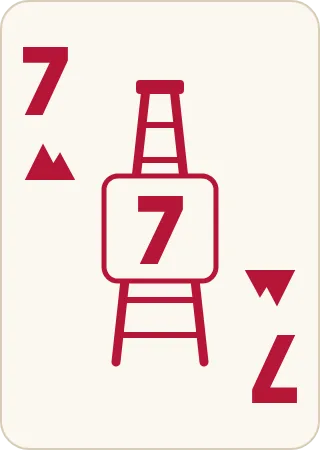
Red number cardsCount: 24
Numbers 1 to 12, two of each, in Red with the mountain symbol. These are natural cards: they fill sets, runs, color groups and color runs. Left in your hand they cost 5 points for numbers 1 to 9 and 10 points for numbers 10 to 12.
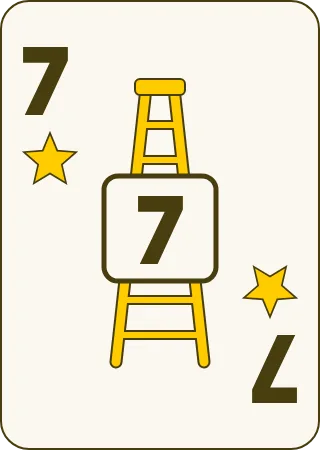
Yellow number cardsCount: 24
Numbers 1 to 12, two of each, in Yellow with the star symbol. These are natural cards: they fill sets, runs, color groups and color runs. Left in your hand they cost 5 points for numbers 1 to 9 and 10 points for numbers 10 to 12.
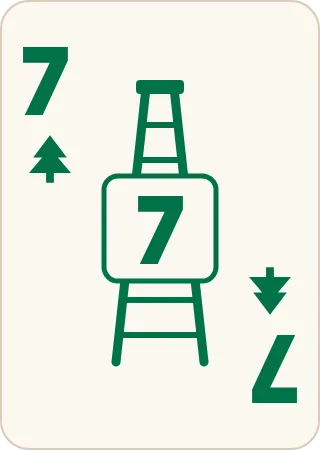
Green number cardsCount: 24
Numbers 1 to 12, two of each, in Green with the tree symbol. These are natural cards: they fill sets, runs, color groups and color runs. Left in your hand they cost 5 points for numbers 1 to 9 and 10 points for numbers 10 to 12.
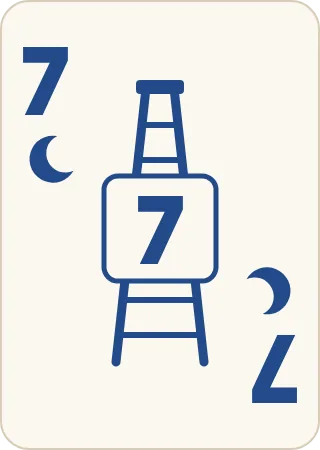
Blue number cardsCount: 24
Numbers 1 to 12, two of each, in Blue with the moon symbol. These are natural cards: they fill sets, runs, color groups and color runs. Left in your hand they cost 5 points for numbers 1 to 9 and 10 points for numbers 10 to 12.

Wild cardsCount: 8
Colorless cards. A Wild stands in for a number card inside a group, as long as the group also holds at least one natural card. It costs 25 points if left in your hand.
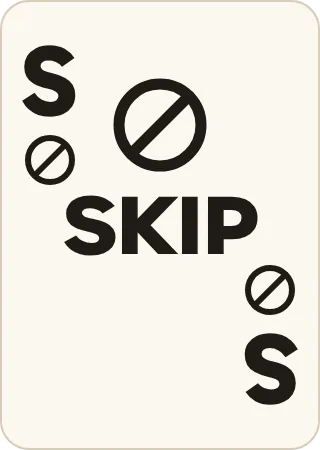
Skip cardsCount: 4
Colorless cards with no number. A Skip is never part of a group. You play it by discarding it and naming a player who loses their next turn. It cannot be taken from the discard pile, and it costs 15 points if left in your hand.
108 cards in all.

Draw pileCount: 1
The face-down cards left after the deal. You may draw the top card at the start of your turn.
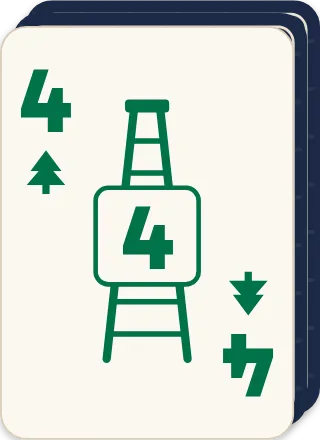
Discard pileCount: 1
A face-up pile that starts with one card. Only the top card matters: at the start of your turn you may take it instead of drawing, unless it is a Skip.
Everyone is dealt 10 cards and the next card is turned face up to start the discard pile. The rest is the draw pile.
| Players | Cards each | Turned up | Draw pile after the deal |
|---|---|---|---|
| 2 | 10 | 1 | 87 |
| 3 | 10 | 1 | 77 |
| 4 | 10 | 1 | 67 |
| 5 | 10 | 1 | 57 |
| 6 | 10 | 1 | 47 |
Your hand is always shown sorted: by color in the order Red, Yellow, Green, Blue, then by number from low to high, then Wilds, then Skips. There is nothing to sort and no sort button.
Goal
Ladder 11 is a climbing game played over several hands. Every player has a ladder of goals called rungs. On your turn you try to lay down the groups that your current rung asks for, and then to get rid of the rest of your cards.
When a hand ends, everyone who laid down their rung during that hand moves up one rung, whether or not they won the hand. Everyone who did not lay down stays on the same rung and tries it again. Players can therefore be on different rungs at the same time.
Cards left in your hand when a hand ends count against you, so a low total is good. How the whole game ends depends on the Rungs option chosen when the table was set up: with 11 rungs, laying down the top rung wins at once; with 10, 7 or 5 rungs, the game ends after the hand in which someone completes the last rung, and the lowest total wins. See How the game ends.
Setup
The first dealer is chosen by chance. The cards are shuffled and dealt one at a time, clockwise, starting with the player to the dealer's left, until everyone holds 10 cards. The next card is turned face up to start the discard pile, and the cards that remain form the draw pile. The player to the dealer's left takes the first turn.
Everyone starts on rung 1 with a total of 0. In each later hand the deal passes one player to the left.
Two openings are worth knowing:
- If the first card of the discard pile is a Wild, the first player may take it like any other discard.
- If it is a Skip, the first player loses their first turn and counts as just skipped (see Skips). With two players, the dealer therefore takes the first turn.
A turn
Every turn follows the same order.
- Draw one card. Take the top card of the draw pile (a blind draw), or take the top card of the discard pile unless it is a Skip.
- If you have not yet laid down in this hand, you may lay down your rung, all at once.
- Once your rung is down, you may hit as many times as you like: add single cards to any group on the table.
- Discard one card, face up on the discard pile. This ends your turn.
You cannot lay down or hit before you have drawn, and you cannot lay down after you discard, because the discard ends the turn. A hit that uses your last card ends the hand without a discard.
If the draw pile runs out, the discard pile, except its top card, is shuffled to make a new draw pile.
Sets, runs, color groups and color runs
Every rung asks for one or more groups. There are four kinds.
- A set is cards that all stand for the same number, in any colors. Two cards of the same color and number are fine.
- A run is cards that stand for consecutive numbers, one card per number, in any colors. The numbers go up from the first card. A run stays between 1 and 12: there is no wrapping round from 12 to 1, and no number appears twice.
- A color group is cards of one color, with any numbers. Repeated numbers are allowed.
- A color run is a run in which every card is also the same color.
A Skip is never part of a group, either when you lay down or when you hit.
Wilds
A Wild can stand in for any card in any group. In a set it stands for the set's number. In a run it stands for the number of the place it fills. In a color group or a color run it also stands for that group's color. You can use more than one Wild in a group.
There is one limit, the one-natural rule: every group must hold at least one natural card, that is, at least one number card. A group made only of Wilds is not allowed.
Example The one-natural rule
rung 9 asks for a set of 5 and a set of 2; hand includes [R8a, Y8a, W1, W2, W3, B3a, G3a]
- The set of 5 can be Red 8, Yellow 8 and Wilds W1, W2 and W3. All five stand for 8, and Red 8 and Yellow 8 are natural, so the group is legal.
- The set of 2 can be Blue 3 and Green 3, or Blue 3 and a Wild. It cannot be two Wilds, because it would have no natural card.
- Once the Wilds are laid, W1, W2 and W3 stand for 8 for the rest of the hand.
A group needs at least one number card. Wilds fill the other places and keep their value.
The ladder
The ladder has eleven rungs. You climb them in order, starting at rung 1, and you can lay down only your own current rung. Each rung lists the groups you must put down together, at exactly the sizes shown.
The table below lists the eleven rungs, the groups each one asks for and how many cards it uses.
| Rung | Lay down | Cards used |
|---|---|---|
| 1 | Two sets of 3 | 6 |
| 2 | A set of 3 and a run of 4 | 7 |
| 3 | A set of 4 and a run of 4 | 8 |
| 4 | A run of 7 | 7 |
| 5 | A run of 8 | 8 |
| 6 | A run of 9 | 9 |
| 7 | Two sets of 4 | 8 |
| 8 | A color group of 7 | 7 |
| 9 | A set of 5 and a set of 2 | 7 |
| 10 | A set of 5 and a set of 3 | 8 |
| 11 | A color run of 7, the summit | 7 |
The Rungs option decides how many rungs a game uses, always counted from the bottom. With 5 rungs you play rungs 1 to 5; with 7, rungs 1 to 7; with 10, rungs 1 to 10; with 11, the whole ladder. See Table options.
In each example below, the hand is shown after drawing, so it holds 11 cards, and it is sorted. Cards are written as a color letter (R, Y, G or B), a number and a copy letter that tells the two identical cards apart: R5a is Red 5, copy a. A Wild is written as W and a number.
Rung 1: two sets of 3
You need 6 cards. The two sets can be the same number or different numbers.
Example Rung 1, with a Wild hit afterwards
rung 1; hand [R5a, R5b, Y5a, Y9a, G2a, G3a, G7a, B7a, B7b, B9a, W1]
- Lay down a set of 5s: R5a, R5b and Y5a.
- Lay down a set of 7s: G7a, B7a and B7b. Rung 1 is now down.
- Hit W1 onto the set of 5s. The Wild stands for 5 from now on.
- Discard Y9a. The turn ends.
The hand is down to G2a, G3a and B9a, three cards. The rung is down for this hand, so the player climbs when the hand ends.
Rung 2: a set of 3 and a run of 4
You need 7 cards: three of one number, and four in a row.
Example Rung 2
rung 2; hand [R6a, R8a, R11a, Y4a, Y8a, Y12b, G1a, G3a, B5a, B8b, W2]
- Lay down a set of 8s: R8a, Y8a and B8b.
- Lay down a run of 4 from 3: G3a, Y4a, B5a and R6a.
- Discard Y12b.
The hand is down to R11a, G1a and W2, three cards.
Rung 3: a set of 4 and a run of 4
You need 8 cards.
Example Rung 3, with a Wild in the run
rung 3; hand [R3a, R9a, Y5a, Y9a, Y12a, G1a, G9b, B6a, B9a, B11b, W3]
- Lay down a set of 9s: R9a, Y9a, G9b and B9a.
- Lay down a run of 4 from 3: R3a, then W3 standing for 4, then Y5a and B6a.
- Discard Y12a.
The hand is down to G1a and B11b, two cards. W3 stands for 4 until the hand ends.
Rung 4: a run of 7
You need 7 cards in a row. The cards can be any colors.
Example Rung 4, then hitting the high end
rung 4; hand [R4a, R8a, Y1a, Y6a, Y9a, G5a, G10a, G12b, B2a, B7a, B11a]
- Lay down a run of 7 from 4: R4a, G5a, Y6a, B7a, R8a, Y9a and G10a.
- The run now ends at 10. Hit B11a onto the high end; the run now ends at 11.
- Hit G12b onto the high end; the run now ends at 12.
- Discard B2a.
Y1a is the only card left. The run on the table now covers 4 to 12 and takes no more cards on its high end.
Rung 5: a run of 8
You need 8 cards in a row.
Example Rung 5, going out
rung 5; hand [R4a, R8a, Y3a, Y11a, G1b, G5a, G9a, B6a, B10a, B12a, W1]
- Lay down a run of 8 from 3: Y3a, R4a, G5a, B6a, W1 standing for 7, R8a, G9a and B10a.
- Hit Y11a onto the high end. The run now ends at 11.
- Hit B12a onto the high end. The run now ends at 12.
- Discard G1b, the last card.
The hand is empty, so this player has gone out. The hand ends at once and the player adds 0 to their total.
Rung 6: a run of 9
You need 9 cards in a row. This is the largest lay-down in the game.
Example Rung 6
rung 6; hand [R4a, R8a, R12a, Y5a, Y9a, Y12b, G3a, G7a, G10a, B2a, B6a]
- Lay down a run of 9 from 2: B2a, G3a, R4a, Y5a, B6a, G7a, R8a, Y9a and G10a.
- The run now ends at 10, so it needs an 11 on its high end or a 1 on its low end. Neither remaining card fits.
- Discard R12a.
Y12b is the only card left. Kept in the hand when the hand ends, it would cost 10 points.
Rung 7: two sets of 4
You need 8 cards. As in rung 1, the two sets may be the same number.
Example Rung 7
rung 7; hand [R4a, R6a, Y4a, Y6b, Y12a, G4b, G6a, G11a, B1a, B6a, W2]
- Lay down a set of 4s: R4a, Y4a, G4b and W2 standing for 4.
- Lay down a set of 6s: R6a, Y6b, G6a and B6a.
- Discard Y12a.
The hand is down to G11a and B1a, two cards.
Rung 8: a color group of 7
You need 7 cards of one color. The numbers do not matter, and repeats are fine. After this, only cards of that color, and Wilds, can be hit onto the group.
Example Rung 8
rung 8; hand [R7a, Y3a, Y11a, G2a, G2b, G5a, G8a, G10a, G12a, B4a, W3]
- Lay down a color group in green: G2a, G2b, G5a, G8a, G10a, G12a and W3 standing for green. Two Green 2s are fine.
- No remaining card is green, so nothing can be hit onto the group.
- Discard Y11a.
The hand is down to R7a, Y3a and B4a, three cards.
Rung 9: a set of 5 and a set of 2
You need 7 cards. A set of 2 is a complete group on this rung, but it still needs a natural card.
Example Rung 9
rung 9; hand [R3a, R8a, R12a, Y2a, Y8a, Y8b, G4a, G8a, G10a, B3a, B8b]
- Lay down a set of 5 of 8s: R8a, Y8a, Y8b, G8a and B8b.
- Lay down a set of 2 of 3s: R3a and B3a.
- Discard R12a.
The hand is down to Y2a, G4a and G10a, three cards.
Rung 10: a set of 5 and a set of 3
You need 8 cards. With 10 rungs, this is the last rung of the game.
Example Rung 10, with a Wild in each set
rung 10; hand [R9a, R11a, Y2a, Y11a, G2a, G6a, G11b, B11a, B12b, W4, W5]
- Lay down a set of 5 of 11s: R11a, Y11a, G11b, B11a and W4 standing for 11.
- Lay down a set of 3 of 2s: Y2a, G2a and W5 standing for 2.
- Discard B12b.
The hand is down to R9a and G6a, two cards. In a game of 10 rungs the hand now plays on until someone goes out, as described in How the game ends.
Rung 11: a color run of 7, the summit
You need 7 cards in a row, all of one color. This is the hardest rung, the summit. It exists only when the game is set to 11 rungs. Laying it down wins the game at once.
Example Rung 11, the summit
rung 11, 11 rungs in the game; hand [R2a, Y1b, Y10a, G12a, B3a, B4a, B5a, B7a, B8a, B9a, W1]
- Lay down a color run of 7 from 3 in blue: B3a, B4a, B5a, W1 standing for Blue 6, B7a, B8a and B9a.
- The game ends at once. Nobody needs to go out, and no cards are counted.
This player wins the game. Nobody's total changes, and the cards left in the other hands are shown to everyone.
Laying down
You lay down your rung once per hand, on your own turn, after drawing, and all at once. You may not lay it down in pieces over several turns.
- Put down exactly the groups your rung lists, each at exactly its size: no more and no fewer cards.
- If you hold more cards that fit, add them as hits straight afterwards, in the same turn. The table ends up the same as if you had laid down more.
- Every group must be valid, and must hold at least one natural card.
- The credit is immediate: once the rung is down, you climb when the hand ends, even if someone else wins the hand.
- A group that grows by hits counts only for the rung you laid it for. It never counts towards a higher rung.
Hitting
Once your own rung is down in this hand, you may add single cards to any group on the table, yours or another player's, as many times as you like in a turn. You can start hitting on the same turn you lay down.
- A set takes a card of its number, or a Wild.
- A color group takes a card of its color, or a Wild.
- A run takes the next number up from its top card, or the next number down from its bottom card, or a Wild at either end. You say which end.
- A run stops growing at 1 on the low end and at 12 on the high end. A run from 1 to 12 takes no more cards.
- A Wild you hit stands for the number the end gives it, the number of the set, or the color of the group, and is fixed from then on.
Example Growing a run at both ends
a run on the table, from 3 to 6, made of B3a, Y4a, W2 (standing for 5) and R6a; your hand holds [R7a, W3, G1a, ...]
- Hit R7a onto the high end. The run is now 3 to 7.
- Hit W3 onto the low end. The Wild stands for 2, and the run is now 2 to 7.
- Hit G1a onto the low end. The run is now 1 to 7.
No card fits the low end any more. The high end now takes only an 8 or a Wild.
Skips
A Skip is never laid down and never hit. To play it, discard it and name another player. That player loses their next turn.
- You must name a player when you discard a Skip, as long as one of the other players can be chosen. You cannot name yourself, or someone who is not in the hand.
- If every other player is protected, you may discard the Skip without naming anyone, and it does nothing.
- You can never take a Skip from the discard pile. A Skip left in your hand costs 15 points when the hand ends.
- A Skip discarded as your very last card ends the hand, and the player it named is not skipped.
Protection. A player who has just been skipped is protected. They cannot be skipped again until they have finished a turn that they actually took. Protection starts the moment a Skip names a player, not when their turn is lost, and a lost turn does not end it. So nobody ever loses two turns in a row to a Skip, and no second Skip can be aimed at a player who already has one waiting.
Example A Skip and its protection
four players, Ana, Ben, Cara and Dev, seated clockwise in that order; Ben is about to discard a Skip
- Ben discards a Skip and names Dev.
- Cara takes her turn. When she discards, the turn would pass to Dev, but Dev loses it, so Ana plays next.
- Dev is now just skipped. While Dev is protected, Ana, Ben and Cara may name only each other when they discard a Skip.
- Dev takes their next turn. When Dev's turn ends, the protection is gone and Dev can be named again.
A Skip costs one turn, never two in a row.
Going out
You go out when your hand becomes empty. That can happen by discarding your last card, or by hitting it onto a group. A hit that empties your hand needs no discard. You cannot go out without having laid down your rung first.
When a player goes out, the hand ends at once, and every other player counts the cards left in their hand.
Scoring a hand
When a hand ends, every player who still holds cards counts them and adds the points to their running total. The player who went out holds nothing and adds 0. Cards in groups on the table are worth nothing. A low total is good.
The table below says what each card left in a hand is worth.
| Card | Points |
|---|---|
| Number 1 to 9 | 5 |
| Number 10 to 12 | 10 |
| Skip | 15 |
| Wild | 25 |
Climbing is separate from scoring. Everyone who laid down their rung in the hand moves up one rung, whatever their total. Everyone who did not lay down stays on their rung. Skip protection is cleared at the end of every hand.
Example Scoring a hand with three players
three players, Ana, Ben and Cara, all on rung 1 with a total of 0; Ana has laid down rung 1; Ben and Cara have not
- Ana hits her last card onto a group and goes out. Ana adds 0.
- Ben holds a Wild, a Skip and a Red 4: 25 + 15 + 5 = 45. Ben adds 45.
- Cara holds a Yellow 10 and a Yellow 11: 10 + 10 = 20. Cara adds 20.
- Only Ana laid down, so only Ana climbs. Ben and Cara try rung 1 again.
Totals are Ana 0, Ben 45 and Cara 20. Ana is now on rung 2; Ben and Cara are still on rung 1.
How the game ends
How a game ends depends on the Rungs option. The table below shows what is different; the sections after it give the details.
| Rungs | Last rung | How the game ends |
|---|---|---|
| 11 | Rung 11, the summit | The moment someone lays down rung 11, they win. No scoring. |
| 10 | Rung 10 | A normal rung. The game ends at the end of a hand in which someone has completed rung 10. Lowest total wins. |
| 7 | Rung 7 | A normal rung. The game ends at the end of a hand in which someone has completed rung 7. Lowest total wins. |
| 5 | Rung 5 | A normal rung. The game ends at the end of a hand in which someone has completed rung 5. Lowest total wins. |
With 11 rungs: the summit
With 11 rungs, the moment a player lays down rung 11, a color run of 7, that player wins the game. The hand does not finish, nobody has to go out, no cards are counted, nobody's total changes and nobody else climbs. There are no ties to settle.
With 10, 7 or 5 rungs: the last rung is a normal rung
With 10, 7 or 5 rungs, laying down the last rung does not end the game. The hand carries on until a player goes out, as in any other hand.
When the hand ends, find the players who have completed the last rung. Several players can do so in the same hand. A player does not win just by going out: a player who has completed the last rung and has a lower total can win even if somebody else went out.
- If nobody has completed the last rung, play goes on with a new hand.
- If one player has, that player wins.
- If several have, the lowest total, counting the points of the hand just ended, wins.
- If the lowest total is shared, those players, and only those players, play a tie-break hand.
The tie-break hand
A tie-break hand is dealt like any other hand, but only to the tied players. Everyone in it plays the last rung. No points are added, and nobody climbs. The first player to go out wins the game. If a tie-break hand ends with nobody out, another tie-break hand follows with the same players.
Example The lowest total wins among those who completed the last rung
10 rungs; Ana has a total of 70 and Ben has a total of 40; both have laid down rung 10 in this hand
- Ana hits her last card and goes out. She adds 0, so her total is 70.
- Ben holds a Yellow 10 and a Blue 3: 10 + 5 = 15. His total is 55.
- Both players completed rung 10. The lowest total wins.
Ben wins with 55, even though Ana went out.
Example A tied lowest total
5 rungs; three players, Ana, Ben and Cara; Ana had 64 points and Ben had 54; both laid down rung 5; Cara did not
- Ana hits a Green 9 onto the high end of her run of 8 and goes out. She adds 0, so she stays on 64.
- Ben holds one Red 12 worth 10, so he adds 10 and reaches 64.
- Ana and Ben both completed rung 5 and both have the lowest total, 64. A tie-break hand is dealt to Ana and Ben only. Cara sits out.
- In the tie-break hand, Ben goes out first by hitting a Green 9 onto his own run.
Ben wins the game. No points are added in the tie-break hand.
Table options
Ladder 11 has one rule option, Rungs, which this guide also calls the number of rungs. It is a list of four choices, shown in this order: 11, 10, 7 and 5. The default is 10.
| Rungs | What it means |
|---|---|
| 11 | The whole ladder. Laying down rung 11 wins the game at once. |
| 10 | Rungs 1 to 10: the standard game, and the default. |
| 7 | Rungs 1 to 7: a shorter game. |
| 5 | Rungs 1 to 5: a quick game. |
With 11 rungs, laying down rung 11 wins the game at once (the summit rule). With 10, 7 or 5, the last rung is an ordinary rung. The hand is completed, the lowest total wins, and a tie is replayed. See How the game ends.
Every table also has the usual settings for how long a turn may take:
- Real-time table: a turn timer of Relaxed (45 seconds), Normal (30 seconds, the default) or Fast (15 seconds).
- Turn-based table: a time per turn of 12, 24 (the default) or 72 hours, and what happens when the time runs out: a bot plays the turn (the default) or the player forfeits. See Running out of time and leaving.
- Bots: a seat can be given to a bot, with a level of Easy, Normal or Hard. See Bots.
Ladder 11 hands are hidden, so a table cannot be played with several people sharing one screen.
Bots
A Ladder 11 table can include bots. A bot sees only what a player in its seat would see: its own hand, the groups on the table, the top of the discard pile and how many cards each other player holds. It never sees another hand or the draw pile.
- Easy plays a random legal move.
- Normal, the mid level, collects the cards it needs. It lays its rung down as soon as it can, using as few Wilds as it can. It hits whenever a card fits. It takes the discard only when the card brings it closer to its rung or fits a group on the table. It discards the card that costs it least, and it plays a Skip at the player who is furthest along.
- Hard, the expert level, plays in the same spirit but more carefully. It counts the cards it has not yet seen, to judge how likely a good draw is, and uses that to decide what to discard and whether the discard pile is worth taking. It picks the lay-down that leaves it the fewest cards and points once every hit that then fits is made, and it always lays down when it can.
Spectators
Where spectators are allowed, a spectator watches the table but takes no part. A spectator sees the same public information as the players: the groups on the table, the top of the discard pile, every player's rung, total and number of cards, and, when a hand ends, the cards left in each hand. A spectator never sees any player's hand or the draw pile.
Running out of time and leaving
If your turn timer runs out, the game plays a plain move for you so the table can go on. If you have not drawn yet, it draws the top card of the draw pile. Then it discards your heaviest card that is not a Wild. Heaviest means the most points when counted against you, so a Skip comes before numbers 10 to 12, and those come before numbers 1 to 9. A Skip discarded this way is aimed at the first player who can be named. If your hand holds only Wilds, a Wild is discarded. The game never lays down or hits for you, because a player who ran out of time should not be helped to a rung.
At a real-time table, a seat that times out three times is taken over by a bot. At a turn-based table, the table's setting decides: either a bot plays the turn, or the player forfeits.
If you forfeit or leave, the whole game ends at once, not just your part in it. The player who left is ranked last. The other players are ranked by how many rungs they have completed, most first, then by the lowest total, then by seat order, and the first of them wins. The hand in progress is not scored, and everyone's hand is shown.
Quick reference
A turn: draw one card, optionally lay down your rung, optionally hit, then discard one card.
| Rung | Lay down |
|---|---|
| 1 | Two sets of 3 |
| 2 | A set of 3 and a run of 4 |
| 3 | A set of 4 and a run of 4 |
| 4 | A run of 7 |
| 5 | A run of 8 |
| 6 | A run of 9 |
| 7 | Two sets of 4 |
| 8 | A color group of 7 |
| 9 | A set of 5 and a set of 2 |
| 10 | A set of 5 and a set of 3 |
| 11 | A color run of 7, the summit |
- Card points left in hand: numbers 1 to 9 are 5, numbers 10 to 12 are 10, a Skip is 15, a Wild is 25.
- Every group needs at least one natural card. A Wild keeps its value until the hand ends.
- Lay down once per hand, all at once. Hit only after your rung is down.
- A Skip makes a player lose a turn. A player just skipped is protected until they have taken a turn.
- 11 rungs: lay down rung 11 and you win. 10, 7 or 5 rungs: the hand ends, and the lowest total among those who completed the last rung wins.
Glossary
- Climb
- Moving up one rung after a hand in which you laid down your rung. You climb whether or not you won the hand.
- Color group
- Cards of one color with any numbers, repeats allowed. Rung 8 asks for a color group of 7.
- Color run
- A run in which every card is also the same color. Rung 11, the summit, asks for a color run of 7.
- Forfeit
- Leaving a game in progress. It ends the whole game at once, and the player who left is ranked last.
- Group
- A set, a run, a color group or a color run. Every rung asks for one or two groups.
- Hit
- Adding one card from your hand to a group on the table, after your own rung is down in that hand.
- Lay down
- Putting your whole rung on the table at once. You can do it once per hand, on your own turn, after drawing.
- Natural card
- A number card. Every group needs at least one natural card, so Wilds alone are not enough.
- Protection
- The safeguard of a player who has just been skipped. They cannot be named by a Skip again until they have finished a turn they actually took.
- Run
- Cards that stand for consecutive numbers, one card per number, in any colors. A run stays between 1 and 12.
- Rung
- One goal on the ladder, such as two sets of 3 or a run of 7. There are eleven rungs, and the Rungs option decides how many your game uses.
- Set
- Cards that all stand for the same number, in any colors.
- Skip
- A colorless card you discard to name a player who loses their next turn. It can never be part of a group or taken from the discard pile.
- Summit
- Rung 11, a color run of 7. In a game of 11 rungs, laying it down wins the game at once.
- Tie-break hand
- An extra hand played by only the players who share the lowest total after the last rung is completed. The first player out wins.
- Wild
- A colorless card that stands in for any number, and in a color group the color as well. It keeps that value for the rest of the hand, and every group needs at least one natural card.