The cards
The game uses one deck of 112 cards. Each card has a light face on one side and a dark face on the other. The two faces that share a card are fixed, and are the same in every game. There are no zero cards.
The light side has four colors, Red, Yellow, Green and Blue, with the symbols flame, sun, leaf and wave. The dark side has four different colors, Magenta, Cyan, Orange and Purple, with the symbols moon, gem, bolt and star. Light cards are printed on cream card. Dark cards are printed on very dark card with a double thin line inside the edge. The two sets never share a color or a symbol, so you cannot mistake one side for the other.
Every card also shows its name in words and its own picture, and the table always shows which side is in play. The lists below give the cards of each side. Each side adds up to 112 cards, because every card has one face of each side.
Light side: 112 faces
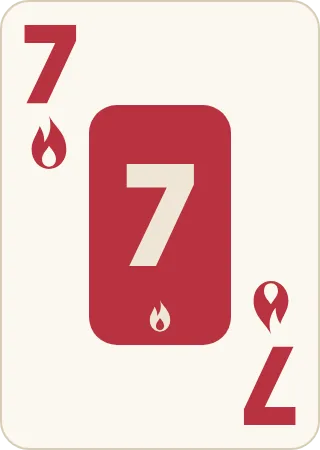
Light Red number cardsCount: 18
Numbers 1 to 9, two of each, in Red with the flame symbol on cream card. They have no effect. They only have to match the top card by color or number, and count the number on them if scored.
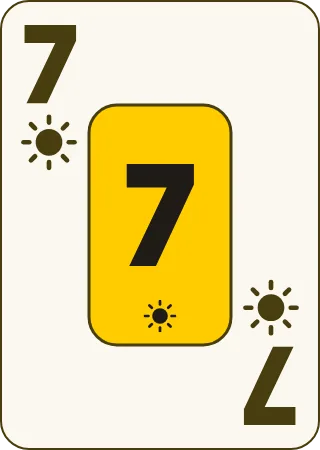
Light Yellow number cardsCount: 18
Numbers 1 to 9, two of each, in Yellow with the sun symbol on cream card. They have no effect. They only have to match the top card by color or number, and count the number on them if scored.
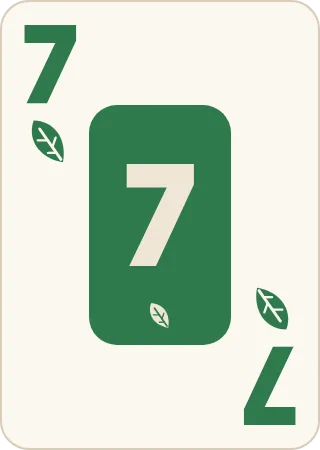
Light Green number cardsCount: 18
Numbers 1 to 9, two of each, in Green with the leaf symbol on cream card. They have no effect. They only have to match the top card by color or number, and count the number on them if scored.
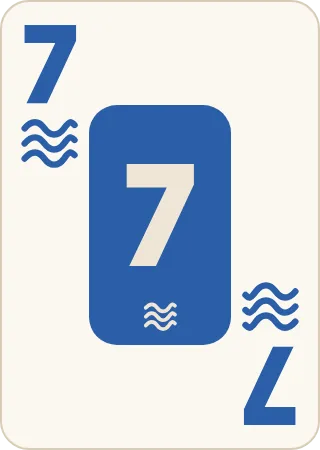
Light Blue number cardsCount: 18
Numbers 1 to 9, two of each, in Blue with the wave symbol on cream card. They have no effect. They only have to match the top card by color or number, and count the number on them if scored.
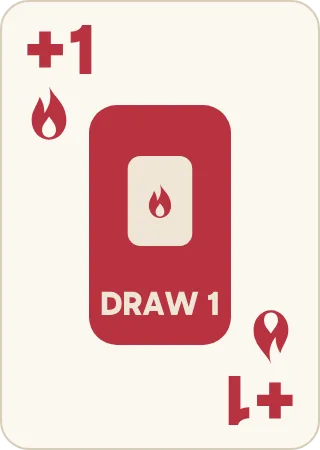
Light Draw One cardsCount: 8
Two in each light color. The words DRAW 1 and a card with a plus 1. Play it on its color or on another Draw One: the next player draws one card and loses their turn. Worth 10 points if scored.
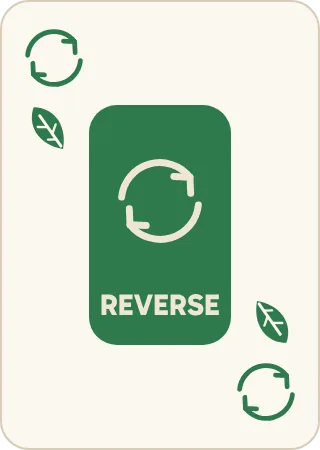
Light Reverse cardsCount: 8
Two in each light color. The word REVERSE and two curved arrows pointing in opposite directions. Play it on its color or on another Reverse: play turns around. Worth 20 points if scored.
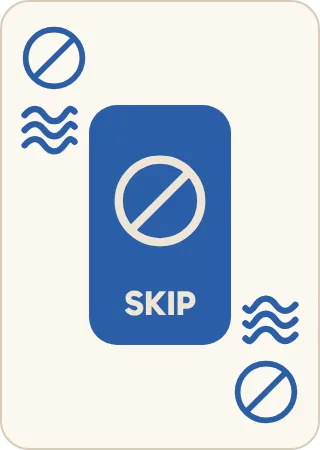
Light Skip cardsCount: 8
Two in each light color. The word SKIP and a circle with a diagonal line through it. Play it on its color or on another Skip: the next player loses their turn. Worth 20 points if scored.
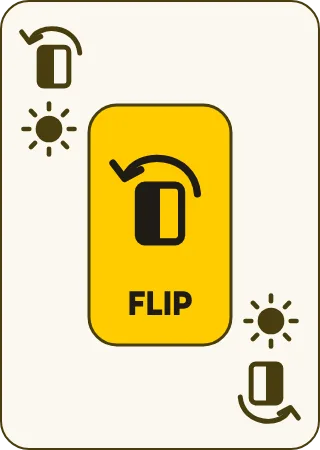
Light Flip cardsCount: 8
Two in each light color. The word FLIP and a card turning over. Play it on its color or on another Flip: every card in the game turns to its dark side. Worth 20 points if scored.
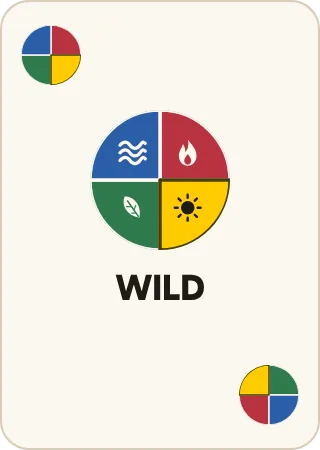
Wild cardsCount: 4
No color of their own. The word WILD and a wheel of the four light colors. Play one on anything and choose a light color. Worth 40 points if scored.
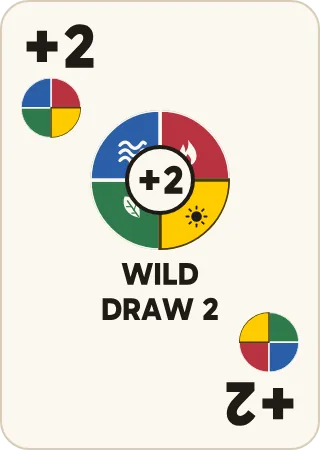
Wild Draw 2 cardsCount: 4
No color of their own. The words WILD DRAW 2 and the light wheel. Choose a light color. The next player draws two cards and loses their turn. You may only play one when you hold no card of the color in play. Worth 50 points if scored.
Dark side: 112 faces
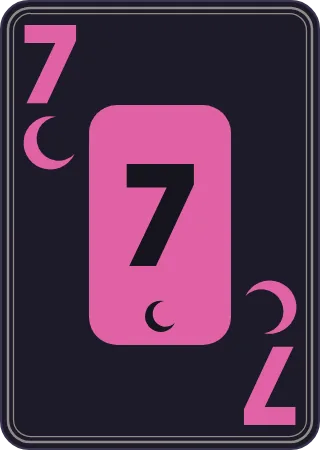
Dark Magenta number cardsCount: 18
Numbers 1 to 9, two of each, in Magenta with the moon symbol on dark card. They have no effect. They only have to match the top card by color or number, and count the number on them if scored.
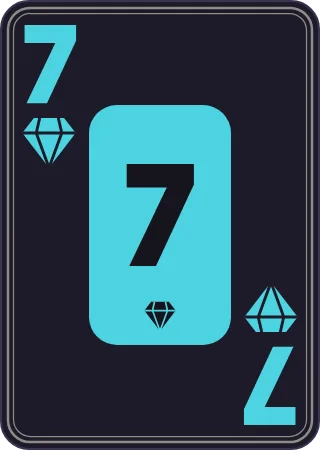
Dark Cyan number cardsCount: 18
Numbers 1 to 9, two of each, in Cyan with the gem symbol on dark card. They have no effect. They only have to match the top card by color or number, and count the number on them if scored.
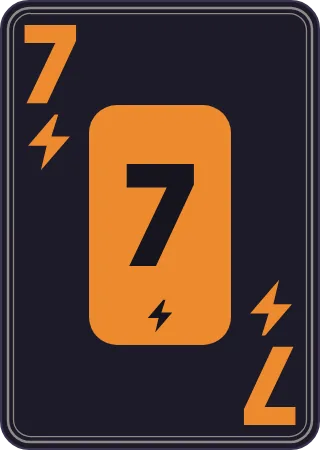
Dark Orange number cardsCount: 18
Numbers 1 to 9, two of each, in Orange with the bolt symbol on dark card. They have no effect. They only have to match the top card by color or number, and count the number on them if scored.
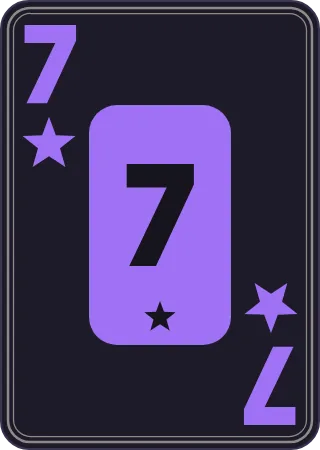
Dark Purple number cardsCount: 18
Numbers 1 to 9, two of each, in Purple with the star symbol on dark card. They have no effect. They only have to match the top card by color or number, and count the number on them if scored.
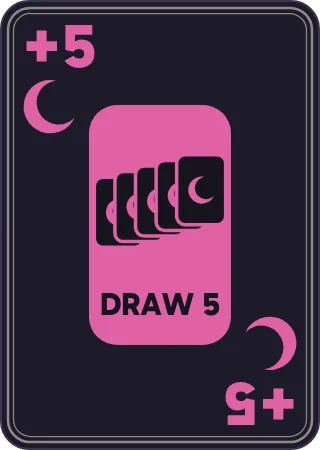
Dark Draw Five cardsCount: 8
Two in each dark color. The words DRAW 5 and a stack of cards with a plus 5. Play it on its color or on another Draw Five: the next player draws five cards and loses their turn. Worth 20 points if scored.
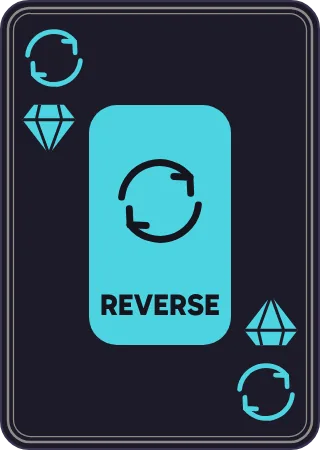
Dark Reverse cardsCount: 8
Two in each dark color. The word REVERSE and two curved arrows pointing in opposite directions. Play it on its color or on another Reverse: play turns around. Worth 20 points if scored.
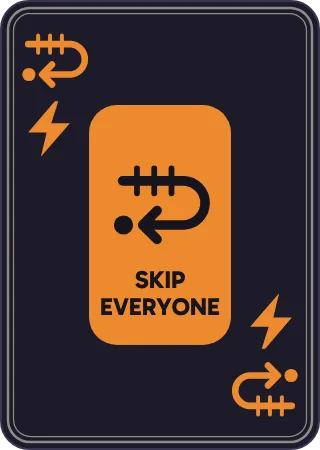
Dark Skip Everyone cardsCount: 8
Two in each dark color. The words SKIP EVERYONE and the circle-and-line sign repeated around a ring. Play it on its color or on another Skip Everyone: every other player loses their turn, and you play again. Worth 30 points if scored.
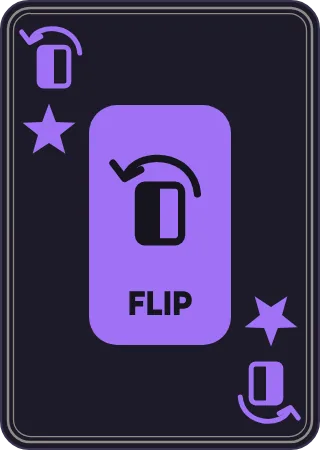
Dark Flip cardsCount: 8
Two in each dark color. The word FLIP and a card turning over, drawn so that it clearly means the same as the light Flip. Play it on its color or on another Flip: every card in the game turns to its light side. Worth 20 points if scored.
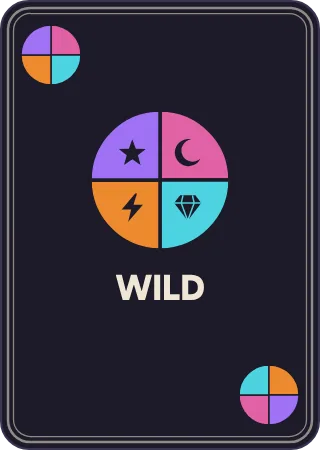
Dark Wild cardsCount: 4
No color of their own. The words DARK WILD and a wheel of the four dark colors. Play one on anything and choose a dark color. Worth 40 points if scored.
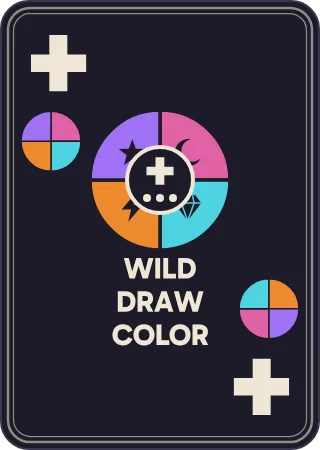
Wild Draw Color cardsCount: 4
No color of their own. The words WILD DRAW COLOR and the dark wheel with a stack of cards and an arrow to the chosen color. Choose a dark color. The next player draws until they draw a card of that color, and loses their turn. You may only play one when you hold no card of the color in play. Worth 60 points if scored.
112 cards in all. Every card has one light face and one dark face, so each side adds up to 112.
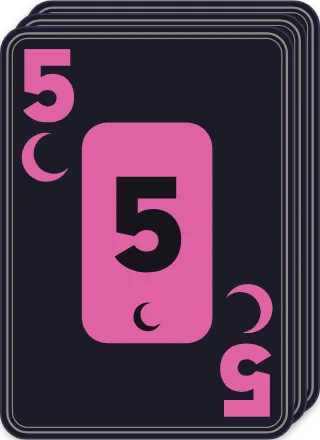
Draw pileCount: 1
A stack of cards. Everyone can see how many cards it holds, and its top card is shown with the face of the side that is not in play. Cards are taken from the top, one at a time.
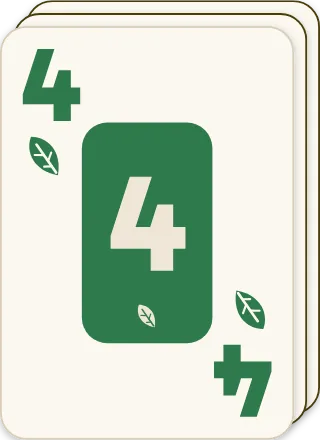
Discard pileCount: 1
A stack of played cards, with the face of the side in play showing. The top card decides what can be played next, and anyone can look through the whole pile in order.
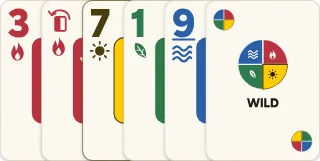
Your handCount: 7
The cards only you can look at. You start with seven, and you see only the faces of the side in play. It is always shown sorted, and it is sorted again after every flip.
Card-count badgeCount: 1 per playerOn screen
A small number next to each player showing how many cards they hold.
Direction ringCount: 1On screen
A ring around the table with an arrow showing which way play is going. It turns around when a Reverse is played.
Every player is dealt seven cards and one card is turned up, light side showing, to start the discard pile. The rest is the draw pile.
| Players | Cards each | Turned up | Draw pile after the deal |
|---|---|---|---|
| 2 | 7 | 1 | 97 |
| 3 | 7 | 1 | 90 |
| 4 | 7 | 1 | 83 |
| 5 | 7 | 1 | 76 |
| 6 | 7 | 1 | 69 |
| 7 | 7 | 1 | 62 |
| 8 | 7 | 1 | 55 |
| 9 | 7 | 1 | 48 |
| 10 | 7 | 1 | 41 |
Goal
Wild Cards Flip is a game about getting rid of things, with a twist: every card has two sides. One side is light and the other is dark. The table is always on one of the two sides, and only that side counts. You play a card by matching the top card, and the first player to empty their hand wins the round.
The twist is the Flip card. When one is played, every card in the game turns over at once, so your hand, everyone else's hand and the piles all change to their other faces. A hand that was awkward a moment ago can suddenly be easy to play, and the other way round. Play carries on, but on the other side.
Setup
You do not shuffle or deal by hand. The table does it, and starts every round on the light side.
- The deck is shuffled, with every card on its light side.
- Every player is dealt seven cards, starting with the player after the dealer. The first dealer is the first seat, and the deal moves to the next player in each new round.
- The top card of what is left is turned over to start the discard pile. This is the starter card, and the color in play is its color, unless it is a Wild.
- Play begins with the player after the dealer and goes clockwise, unless the starter card changes that.
The starter card is always read on the light side, and it can have an effect before the first turn. The first player is the one after the dealer.
| Starter card | What happens |
|---|---|
| A number card | Nothing special. The first player takes the first turn. |
| Draw One | The first player draws one card and loses their turn. |
| Skip | The first player is skipped. The player after them goes first. |
| Reverse, three or more players | Play turns around. The dealer goes first. |
| Reverse, two players | It works like a Skip, so the dealer goes first. If the two-player Reverse option is off, it turns play around and the dealer goes first. |
| Wild | The first player chooses the color, then takes the first turn. |
| Wild Draw 2 or Flip | It can never start the game. It goes back into the draw pile, the pile is reshuffled and a new card is turned. |
A turn
On your turn you play one card, or, if you have nothing you can play, draw. Only the faces of the side in play matter. The other face of every card is ignored. Here are the steps in order.
- Look at the top card of the discard pile and at the color in play.
- If you hold any playable card, you must play one. Any playable card will do. You are never forced to pick the best one.
- If you hold no playable card, draw one card. If that card is playable you must play it straight away, even if it is a Flip. If it is not, it stays in your hand and your turn ends.
- If the card you played is a Wild, choose a color from the side in play.
- The card's effect happens, and the turn moves on.
A card is playable when its active face, the face of the side in play, meets at least one of these:
- Its color is the color in play.
- It has the same number as the top card.
- It has the same action as the top card, for example a Skip on a Skip of another color.
- It is a Wild. The Wild Draw 2 and the Wild Draw Color have an extra condition, explained under the restricted Wilds.
Example A sample hand on each side
light side, starting hand of seven cards, shown sorted [flame-4, flame-flip, sun-9, sun-draw-one, leaf-reverse, wave-skip, wild]
- The hand lists Red cards first. Red 4 comes before the Red Flip, because numbers come before action cards of the same color.
- Yellow comes next, so the Yellow 9 and then the Yellow Draw One.
- Green Reverse and Blue Skip follow, each the only card of its color. The Wild has no color, so it is last.
- After a flip you would hold the same seven cards, now showing their dark faces and sorted again for the dark side. In this example they read [moon-skip-everyone, gem-6, gem-flip, bolt-4, bolt-8, star-1, star-3].
Whatever you are dealt, you always see your hand sorted, and a card you draw slots into its place straight away. On the dark side the order runs Magenta, Cyan, Orange, Purple.
Example Which cards can you play?
light side, top card sun-5, color in play Yellow; hand [flame-3, flame-5, sun-9, leaf-reverse, wave-2, wild]
- Red 3 is not Yellow and is not a 5, so it cannot be played.
- Red 5 has the same number as the top card, so it can be played.
- Yellow 9 is Yellow, so it can be played.
- Green Reverse and Blue 2 match neither the color nor the number, so they cannot be played.
- The Wild can always be played.
You have three playable cards: Red 5, Yellow 9 and the Wild. You must play one of them, and you choose which. You may not draw while any of them is in your hand.
Example Plays the table will not accept
light side, top card sun-5, color in play Yellow; hand [sun-9, leaf-2, wild-draw-two]
- You try to play the Wild Draw 2. You hold Yellow 9, a card of the color in play, so the table refuses it and tells you why.
- You try to draw a card instead. The table refuses this too, because Yellow 9 is playable and you must play when you can.
- You play Yellow 9, the only card you may play.
A refused move changes nothing. No card is drawn, you lose no turn, you are not penalised and the turn timer keeps running as before.
When nothing is playable
If you cannot play, you draw exactly one card. It is added to your hand and shown to you with the face of the side in play. If you can play it, you must play it at once. You cannot swap it for another card in your hand, and you cannot keep it and pass. A drawn Flip that you can play must be played, and it flips the table as usual.
The light side
Each light action card does something when it lands on the discard pile. Unless a rule says otherwise, the turn then passes to the next player.
- Draw One. The next player draws one card and loses their turn.
- Reverse. The direction of play turns around. With only two players left in the round, a Reverse works like a Skip, so you take another turn straight away, unless that option is off.
- Skip. The next player loses their turn.
- Wild. Choose a light color. It has no other effect.
- Wild Draw 2. Choose a light color. The next player draws two cards and loses their turn.
- Flip. The table turns to the dark side. See The flip.
The dark side
The dark side is harsher. Its penalties are bigger and one card can take everybody's turn.
- Draw Five. The next player draws five cards and loses their turn.
- Reverse. Exactly as on the light side.
- Skip Everyone. Every other player loses their turn, and play comes straight back to you. You play again.
- Dark Wild. Choose a dark color. It has no other effect.
- Wild Draw Color. Choose a dark color. The next player draws cards one at a time until they draw a card whose dark face is the color you chose, however many cards that takes. They keep every card they drew, and they lose their turn. Wild cards do not stop the drawing. If the piles run out first, the drawing just stops.
- Flip. The table turns to the light side.
The restricted Wilds
The Wild Draw 2 and the Wild Draw Color are powerful, so each has a limit. You may play one only when you hold no card whose face on the side in play has the color in play. Only that exact color blocks it. These do not block it:
- A Wild showing on the side in play, because Wilds have no color.
- A card that matches the top card by number or action in a different color.
- The other face of any card. Only the faces of the side in play are looked at.
- Another Wild Draw 2 or Wild Draw Color.
If your hand does hold a card of the color in play, the restricted Wild simply cannot be played, and the table will not accept the attempt. You must play another playable card, and that color card is playable by definition. The plain Wild and the Dark Wild are never restricted.
Example Wild Draw Color: allowed and blocked
dark side, three players. Top card moon-6, color in play Magenta. Hand A [gem-2, bolt-4, Wild Draw Color]. Hand B [moon-3, gem-2, Wild Draw Color]
- Hand A holds no Magenta card. Cyan 2 and Orange 4 are not Magenta. The Wild Draw Color can be played.
- A plays it and chooses Cyan. The next player draws, one card at a time, until they draw a Cyan card. They draw Magenta 5, Purple 1, a Dark Wild and finally Cyan 6, and keep all four. Then they lose their turn.
- Hand B holds Magenta 3, a card of the color in play. The Wild Draw Color cannot be played, and the table refuses the attempt without any penalty.
- B is not allowed to draw either, because Magenta 3 is playable. B must play Magenta 3.
The same card gave two different results. B still holds the Wild Draw Color for a later turn, when no card of the color in play is in the hand.
The flip
When a Flip card is played, three things happen at once, in this order.
- The discard pile is turned upside down in order. The Flip card you played goes to the bottom, and the card that was at the bottom of the pile is now on top.
- The draw pile is reversed in the same way. The card that was at the bottom is now the next card to be drawn.
- The table changes side. Every card in every zone now has its other face in play, including every hand.
Then the color in play is set from the new top card of the discard pile, using the face now showing, and play passes to the next player in the same direction. The player who flipped has finished their turn, and the direction of play does not change.
- The next card played must match the new top card, using the faces of the new side, or be a Wild.
- No effect fires for a card that becomes the top card because of a flip. It only supplies its color and its number or action for matching.
- Hand sizes and whose turn it is do not change. What changes is which cards can be played, because every hand is looked at again on the new side.
- If the new top card is a Wild, it has no color. The player whose turn it is chooses a color from the new side first, and then plays.
- The side stays until another Flip is played, and flips can go back and forth as often as they come up.
Example What a flip does to the piles
light side, color in play Red. The discard pile holds four cards, bottom to top: three cards and then your Red Flip. The draw pile's next three cards are A, B and C, with A on top
- You play the Red Flip. It goes on top of the discard pile, and the table turns over.
- The discard pile is reversed. The Flip card is now at the bottom, and the card that was at the bottom is on top, showing its dark face. Suppose that face is Cyan 3 (gem-3).
- The draw pile is reversed too. The next cards to be drawn are now C, B and A, in that order.
- The color in play is now Cyan, and the table is on the dark side. The next player must play a Cyan card, a 3, or a Wild, looking only at their dark faces.
Your turn is over and nothing was drawn. If the card that became the top had been a Wild, the next player would choose the color before playing.
Example The same hand, read again after a flip
light side, top card sun-5, color in play Yellow. Your hand [sun-9, leaf-2, wave-2]
- On the light side the only playable card is Yellow 9. Green 2 and Blue 2 match neither the color nor the number.
- Another player plays a Flip, and the table turns over. Your three cards now show their dark faces and read [moon-3, bolt-4, Wild Draw Color].
- Suppose the new top card is Cyan 6, so Cyan is the color in play. Nothing in your hand is Cyan, so the Wild Draw Color can be played.
- Suppose instead that the new top card is Magenta 8. Magenta 3 is a card of the color in play, so the Wild Draw Color is blocked and you must play Magenta 3.
Which cards can be played, and whether you may draw, is worked out again from scratch after every flip, using only the faces of the new side.
Special cases
What you see
You see the face of the side in play on each of your own cards. You never see the other face of your own cards. The other players are the other way round: on a card in someone else's hand, you see the face of the side that is not in play, so you see the faces they cannot play from. You can see how many cards everyone holds. The top card of the draw pile is shown to everyone with its other face, and the discard pile is shown with the face of the side in play, in order. Nobody sees both faces of the same card at the same moment.
When the table flips, the views swap. Your own hand now shows the faces the other players were looking at. Every other hand now shows the faces its owner was playing from.
When the draw pile runs out
If a card must be drawn and the draw pile is empty, every card in the discard pile except the top one is shuffled to make a new draw pile. The new pile is laid out with its other face showing, as always. The side in play does not change. If there is nothing at all to draw, a short draw simply draws fewer cards, and a Wild Draw Color penalty stops when the piles are empty. A player who cannot play and cannot draw passes. A player who can play must still play.
Two players
With two players, Skip lets you play again, and so does Skip Everyone. A Reverse works like a Skip, unless the option "Two-seat Reverse acts as Skip" is switched off. With the option off, a Reverse only turns the direction around, and the other player takes the next turn. "Two players" counts the players still in the game, so a table of three that has lost a player plays the two-player rule.
A round nobody can finish
In the very rare case that nobody can play and nothing can be drawn, the round is blocked. Nobody wins it and nobody scores. See How it ends for what follows.
Scoring
When a round ends because a player played their last card, that player wins the round and scores points. The points are the total value of all the cards left in the other players' hands. Your own hand is empty, so you never lose points, and the other players do not change their scores.
The cards are counted on the scored side, which is the side that was in play when the winning card was played. Each card is valued by its face on that side, which is the face its holder was playing from, even though you may have been looking at the other one. A winning Flip does not flip the table, so the scored side is the side the Flip was played on.
| Face | Light side | Dark side |
|---|---|---|
| Number 1 to 9 | The number | The number |
| Draw One | 10 | not on this side |
| Draw Five | not on this side | 20 |
| Reverse | 20 | 20 |
| Skip | 20 | not on this side |
| Skip Everyone | not on this side | 30 |
| Flip | 20 | 20 |
| Wild, Dark Wild | 40 | 40 |
| Wild Draw 2 | 50 | not on this side |
| Wild Draw Color | not on this side | 60 |
If the last card was a Draw One, Draw Five, Wild Draw 2 or Wild Draw Color, the next player draws 1, 5, 2 or until the chosen color, and the cards they drew count in the total too. The winner chooses the color for a Wild Draw Color. A Reverse, Skip, Skip Everyone, Wild or number card has no effect as the last card.
Example Counting up a finished round
dark side, three players. Player 1 plays their last card. Player 2 holds [moon-skip-everyone, bolt-4, Wild Draw Color]. Player 3 holds [gem-flip]
- The round was won on the dark side, so every card is counted by its dark face.
- Player 2 holds Magenta Skip Everyone (30 points), Orange 4 (4) and a Wild Draw Color (60), which is 94.
- Player 3 holds a Cyan Flip, which is 20.
- Add them: 94 plus 20 is 114.
Player 1 scores 114 points for the round. If the winning card had been a Flip played on the light side, the same cards would be counted by their light faces instead.
How it ends
A round ends when a player plays their last card, which is the usual way. It also ends if it is blocked, or if so many players leave that fewer than two remain.
What happens next depends on the Scoring option chosen when the table was set up:
- Single round (the default). The game ends with the first round that has a winner. That player wins, and the points from the round are recorded as their score. A blocked round ends the game with no winner.
- Play to a target score. Rounds keep coming. The next dealer is the next player, the deck is shuffled again and every round starts on the light side. Scores are carried over, and the first player whose total reaches the target wins the game. You can set the target to 250, 500 or 1000, and it starts at 500. A blocked round scores nothing and a new round is dealt.
When the game is over, players are ranked. Players who stayed to the end come before players who left. The winner is first. After that, a higher score ranks higher, and if scores are equal, the player with fewer points left in hand in the last round ranks higher. Players still level share a rank.
Options
The person who sets up the table picks the number of players, from 2 to 10, and a few options. All of them apply to everyone for the whole game.
Two-seat Reverse acts as Skip
On by default. With two players, a Reverse works like a Skip, so you play again. Switch it off and a Reverse only turns the direction around. This also applies to a starter Reverse.
Scoring and target score
Choose a single round, or play to a target score of 250, 500 or 1000, as described under How it ends. A single round is the default, and the default target is 500.
Not offered
Stacking draw cards, jump-in and the 7-0 swap are not part of Wild Cards Flip. You also cannot look at the other face of your own cards, and there is no option to change that.
Playing at a table
Wild Cards Flip can be played in real time or turn by turn. It cannot be played with several people sharing one device, because each hand has to stay private. Any seat can be filled by a bot.
Time limits
In real time the host picks a move timer: Relaxed (45 seconds), Normal (30) or Fast (15). In turn-by-turn play the host picks a deadline for each turn of 12, 24 or 72 hours, and a reminder goes out at the halfway point. When time runs out, the table makes a plain legal move for you: it plays the card whose face on the side in play is worth the most points, or draws if nothing can be played, or chooses a color if one is needed. Time running out never makes you draw while you hold a playable card.
In real time, a player who runs out of time three times, not necessarily in a row, is replaced by a bot for the rest of the game. In turn-by-turn play, when a deadline passes the host's choice at setup applies: either a bot plays the turn, or the player is treated as having left the game.
Bots and difficulty
A bot can take any seat. Bots come at three levels, Easy, Normal and Hard. A level only changes how well a bot chooses between legal moves. It never changes a rule. A bot sees exactly what a person in its seat would see, and it can only make moves that you could make.
If you disconnect
If you lose your connection in a real-time game, your seat is held for two minutes. After that a bot plays for you until you return. A disconnect never changes the rules or your cards.
Leaving a game
You can concede from the in-game menu. Your cards go to the bottom of the draw pile and you take no further part. If you leave while you are choosing a color for a starter Wild or for a Wild that a flip turned up, the choice passes to the next player. If two or more players remain, the round goes on. If only one player remains, that player wins at once and no points are scored for the interrupted round. Scores you already had are kept for the final ranking, but you rank below everyone who stayed.
Watching a game
Tables do not currently offer spectators. If watching is switched on for a table, a watcher only ever sees what is public: hand sizes, the discard pile and the draw pile size, and never the faces of any player's cards.
Quick reference
| Light side card | What it does |
|---|---|
| Number | Nothing. Match by color or number. |
| Draw One | The next player draws one and loses their turn. |
| Reverse | Direction turns around. With two players it works like a Skip. |
| Skip | The next player loses their turn. |
| Flip | Everything turns to the dark side. |
| Wild | Choose a light color. |
| Wild Draw 2 | Choose a light color. The next player draws two and loses their turn. Only if you hold no card of the color in play. |
| Dark side card | What it does |
|---|---|
| Number | Nothing. Match by color or number. |
| Draw Five | The next player draws five and loses their turn. |
| Reverse | Direction turns around. With two players it works like a Skip. |
| Skip Everyone | Everyone else loses their turn. You play again. |
| Flip | Everything turns to the light side. |
| Dark Wild | Choose a dark color. |
| Wild Draw Color | Choose a dark color. The next player draws until they get that color and loses their turn. Only if you hold no card of the color in play. |
| If this is true | You must |
|---|---|
| You hold a playable card on the side in play | Play one. You cannot draw or pass. |
| You hold no playable card | Draw one card. Play it if you can, otherwise your turn ends. |
| Nothing to play and nothing to draw | Pass. |
Glossary
- Action card
- Any card face that is not a number: Draw One, Draw Five, Reverse, Skip, Skip Everyone, Flip and the Wild cards. Each does something when it is played.
- Active face
- The face of a card on the side in play. It is the only face that counts for matching, playing and scoring.
- Blocked round
- A round in which nobody can play and nothing can be drawn. Nobody wins it and nobody scores.
- Color in play
- The color that the next card must match, unless it matches by number or action or is a Wild. It is the color of the top card on the side in play, or the color chosen after a Wild.
- Dark side
- The side of the cards with Magenta, Cyan, Orange and Purple, and the Draw Five, Skip Everyone, Dark Wild and Wild Draw Color cards.
- Discard pile
- The pile that played cards go on, with the face of the side in play showing. Its top card decides what can be played next.
- Draw pile
- The pile that cards are drawn from. Everyone can see its top card with the face of the side that is not in play, and how many cards are left.
- Flip card
- A card, on either side, that turns every card in the game to its other side and reverses both piles.
- Hand
- The cards a player holds. Only that player sees them, and only the faces of the side in play. They are always shown sorted, and sorted again after every flip.
- Inactive face
- The face of a card on the side that is not in play. You never see it on your own cards, but you see it on the cards in other players' hands.
- Light side
- The side of the cards with Red, Yellow, Green and Blue, and the Draw One, Skip, Wild and Wild Draw 2 cards. Every round starts on this side.
- Penalty
- A number of cards a player has to draw because of a Draw One, Draw Five, Wild Draw 2 or Wild Draw Color. There is no stacking in Flip, so a penalty always lands at once.
- Playable
- A card that can legally be played right now. Its active face matches the color in play, matches the top card by number or action, or is a Wild. A Wild Draw 2 or Wild Draw Color is only playable if the hand holds no card of the color in play.
- Reshuffle
- When the draw pile is empty and a card is needed, the discard pile except its top card is shuffled to make a new draw pile. The side in play does not change.
- Round
- One deal, played until someone plays their last card or the round is blocked. A game is one round or several, depending on the Scoring option.
- Scored side
- The side that was in play when the winning card was played. Leftover cards are valued by their faces on that side.
- Side
- Light or dark. The whole table is always on one side, and a Flip card changes it.
- Skip Everyone
- A dark Skip card that makes every other player lose their turn, so the player who played it plays again.
- Starter card
- The first card turned face up to begin the discard pile, read on the light side. A Wild Draw 2 or a Flip can never be the starter.
- Target score
- In a game played to a target, the total a player must reach to win. You can choose 250, 500 or 1000.
- Wild card
- A card with no color that can be played on anything. The player who plays it chooses the color from the side in play.
- Wild Draw Color
- A dark Wild. The next player draws until they get a card of the chosen color, keeps them all, and loses their turn.